
.png)

Direct effects of Blockchain testing on financial risk, regulatory compliance, and platform viability in the long term. Smart contract security breaches may cause permanent loss of assets, loss of liquidity, and immediate damage to reputation. Even a single unpatched vulnerability can impact whole protocols in high-value decentralized ecosystems.
ROI of blockchain testing goes beyond cost reduction. Successful testing plans minimize the risk of exploits, maximize gas usage, readiness to comply, and secure user assets at scale. The choice of an outsourced or in-house testing model determines the cost structure, the speed of delivery, the availability of specialized expertise, and the general coverage of security.
To choose the appropriate strategy, it is necessary to balance control of operations and extensive technical expertise, particularly in the context where permanence removes the chances of post-implementation corrections.
What Makes Blockchain QA Technically Complex and High-Risk?
Blockchain QA is a technology working on immutable architectures where smart contract logic directly executes financial transactions. Contract design or implementation errors may interfere with state transitions, create reentrancy risks, or add to the cost of gas, which impacts the reliability of a transaction and network performance.
Smart contracts closely bind together various risk vectors:
- State control failures that affect the flow of contracts.
- Reentrancy vulnerabilities that allow the exploitation of funds.
- Gas optimization problems that are raising transaction costs.
Contrary to the traditional applications, there is very limited defect resolution post-deployment. Frontend bugs can quickly be iterated over, whereas bugs in smart contracts can fix assets or open the protocol to attacks forever.
This sensitive setting requires stringent testing policies, such as security testing, formal verification, and multi-layered test coverage, to guarantee both valid functionality and financial safety.
What Makes Blockchain QA Different from Traditional Testing
What Makes Blockchain QA Actually Different
Most software testing is relatively straightforward. If a button works and data loads correctly, the system is considered stable.
Blockchain testing is more complex. Code logic operates in an environment where real financial value is constantly at risk. If calculations fail, consensus can break. State transitions, reentrancy protection, and gas optimization are tightly interconnected. Every line of Solidity code directly affects transaction cost and execution reliability.
A frontend defect can typically be resolved within hours. A smart contract defect can permanently lock funds and cannot be corrected after deployment. Liquidity pools can be drained, and digital assets can be lost. The attack surface also extends into cryptography and consensus mechanisms, increasing both technical complexity and risk.
The Real Cost of Missing Defects
In August 2022‚ $190 million was drained from Nomad Bridge‚ using a missing initialization validation check․ The Nomad contract had been audited before deployment․ The post-mortem of the operation was covered by CoinDesk and remains one of the most studied․
Delays in token launches destroy value in the same way: they push supply timetables back․ Token staking platforms wait․ DApp releases are delayed․ Markets move fast․ They beat you to the market‚ and by the time you arrive‚ the early adopter advantage is gone․
Regulations are also an issue with the UK‚ UAE, and Australian financial regulators requiring cryptocurrency businesses to submit testing evidence‚ meaning that gaps in blockchain testing strategy lead to fines and indefinite delays in approvals to operate that have no known timelines․
In-House Blockchain Testing (The Reality)
What Building In-House Actually Takes
Building in-house testing requires:
- One blockchain QA engineer: knows Solidity, smart contract testing, and regression frameworks. Salary: £55k - £85k London, $80k - $140k US.
- One security person: validates blockchain security testing, runs vulnerability checks.
- Infrastructure: testnet nodes, Ethereum forking, blockchain testing tools like Truffle, CI/CD setup.
- Integrations: API testing, blockchain monitoring, threat detection.
Training lag is brutal. Most developers lack smart contract QA expertise. Ramp-up takes 6-12 weeks before independent contribution. Teams pay salaries for nonexistent work. Honestly, we see this constantly.
The Hidden Costs Nobody Mentions
Recruiting blockchain QA engineers takes 4-6 months in competitive markets. Meanwhile? Development ships untested code. Defects stack up invisibly.
Upskilling is the trap nobody talks about. QA engineers know traditional software testing. Smart contract patterns? Solidity antipatterns? Blockchain performance testing trade-offs? They don't know this. Training costs £1,500 - £3,000 per engineer. Mentoring burns 3 months of senior developer time.
Tool licensing snowballs. Automated smart contract testing platforms: $500 - $2,500 monthly. Code analysis tools: $300+ monthly. Running private blockchain nodes and testnet replicas: £800 - £1,200 monthly. It compounds fast.
Where In-House Actually Wins
In-house teams excel when DApp differentiation relies on custom smart contract logic. Teams own every test case. Testing cadence aligns perfectly with engineering sprints.
Proprietary blockchain solutions benefit most. Custom consensus? Novel liquidity strategies? Testing feedback integrates into architecture conversations immediately. Internal teams know the codebase intimately.
Regulatory advantage exists, too. Compliance teams sometimes demand testing under operational control. Financial regulators often require this for audit trails. In-house keeps documentation cleaner.
Outsourced Blockchain Testing (Speed and Expertise)
How Third-Party Blockchain Testing Actually Works
Third-party blockchain testing starts with a 2-3 week scoping. Teams share smart contract code, architecture diagrams, and threat models. Testing vendors map blockchain testing checklist against industry standards and specific DApp requirements.

Execution varies wildly. Some teams request deep smart contract testing across all contracts pre-mainnet. Others phrase it: unit testing during development, then blockchain security testing and regression cycles before launch.
Managed blockchain testing contracts include retainer models: £8,000 - £20,000 monthly for ongoing blockchain functional testing, regression cycles, and compliance documentation. One-time outsourced blockchain testing costs typically range from £40,000 to £150,000, depending on codebase size and security depth.
Cost Advantages (And Real Vendor Risks)
Speed is the primary advantage. BNXT.ai deploys experienced smart contract testing engineers within days. Defect escape rate drops because testers have audited thousands of Solidity patterns across DeFi, NFT development, and cryptocurrency wallets. They've seen vulnerabilities before.
Outsourced blockchain QA scales without hiring overhead. Need surge capacity for pre-launch security testing? Add testing cycles without building permanent teams. Overhead stays fixed. Testing coverage expands.
Vendor lock-in is genuinely risky, though. Switching outsourced blockchain testing providers mid-project loses accumulated context. New testers must relearn smart contract architecture. Testing cycles restart. Context loss costs real money.
NDA compliance and security protocols matter too. Third-party blockchain testing teams access proprietary smart contract code. Reputable vendors like BNXT.ai operate under ISO 27001 certification, maintain security audits, and follow GDPR protocols. But that oversight adds cost.
When Outsourcing Consistently Wins
Startups launching first tokens benefit most from outsourced blockchain testing. Hiring overhead disappears. Upskilling delays don't exist. Teams pay for expertise when needed. No salary-plus-benefits year-round.
Rapid time-to-market scenarios favor outsourcing hard. Competitive window closes in 8 weeks? Building an in-house team isn't happening. Third-party blockchain testing teams compress timelines 40-60%. Speed wins markets.
Teams entering new blockchain ecosystems gain from outsourced expertise. Moving from Ethereum to Solana? Outsourced blockchain QA engineers know Solidity patterns and Rust-based smart contract programming. Internal ramp-up takes months. Outsourcing collapses that timeline.
Compliance-driven launches also justify the outsourced blockchain testing cost. Regulators in fintech want independent testing evidence from qualified third parties. Reports from outside vendors carry more weight than internal logs. Sometimes they're actually required for approval.
In-House vs Outsourced
Ultimately, it is a trade-off between speed‚ skill, and cost․ Each model has its advantages in some contexts‚ and disadvantages and risks in others․ The table below distinguishes between the two․

Security and Liability: Who Takes the Hit?
In-house testing keeps liability internal. Team's own defect escape rate. Companies face regulatory consequences if smart contract flaws surface post-launch. Full control over remediation.
Outsourced blockchain testing introduces shared liability. Most vendors provide testing reports but disclaim liability for missed vulnerabilities beyond scope. Contracts matter. BNXT.ai includes documented testing methodology and comprehensive smart contract coverage.
Compliance documentation differs, too. Regulators expect in-house teams to maintain continuous testing logs. Outsourced blockchain QA requires clear handoff documentation: what testing occurred, what scope was excluded, and liability assignment. Confusion kills deals.
Time-to-Market: The Real Differentiator
The 12-week-earlier launch of DeFi protocols has a first-mover liquidity benefit. The unlock of the token is capitalized. Market cap is higher on the first launch than on the delayed. In the case of the majority of startups, time-to-market determines it all.
On-site blockchain testing will be another 8-12 weeks. The whole timeline is taken up by hiring and training. Blockchain QA that is outsourced reduces time to 2-3 weeks. There is no sequential scoping or execution, but parallel execution.
Consider a hypothetical scenario: A DeFi protocol is valued at the target launch price of £50 million. The projected growth of 2% monthly post-launch contributes approximately 1 million monthly. The growth that was lost each week because of the loss of the launch is about 250,000. The wastage of ten weeks is equivalent to 2.5 million worth of loss. That number presupposes the absence of any competition, which is launched within the same period.
Long-Term Quality (Which Model Improves)
In-house teams improve over time. Engineers learn the codebase deeply. Testing speed increases. Defect escape rate drops in year two and year three.
Outsourced blockchain testing teams deliver consistent quality but less organizational learning. Each engagement resets context. Internal engineers don't absorb blockchain testing best practices as directly.
Hybrid approaches actually compound value best. In-house engineers own blockchain functional testing and regression cycles. Outsourced blockchain QA handles security testing, smart contract unit testing, and pre-launch audits. Knowledge flows inward. Quality compounds.
Blockchain Testing ROI Metrics: What to Track and Benchmark
Blockchain testing model effectiveness is determined by five measures. They both compare the performance of the inside with the outsourced performance. Monitoring all five will allow informed resourcing.
Defect escape rate (production defects): The target should be less than 2%. The average in-house teams are 3-5 percent in the first year, and 1-2 percent in the third year. Typically, outsourced blockchain QA engagements deliver 1-3 percent initial gains.
Smart contract coverage (code paths visited): The goal is 90% or higher. To attain this level, disciplined and systematic testing is necessary. It is necessary to have comprehensive coverage of smart contract unit tests.
Regression cycle time (time to commit and test): It is assumed that active DeFi protocols will have a cycle of 4-6 hours. At this level, the outsourced teams may start performing at such a level, whereas in-house teams may only achieve the same level of efficiency after a period of 6-9 months of maturity of the process.
Price per bug found: In-house models usually cost between £5,000 and £15,000 per bug. Blockchain testing costs on average £3,000 8,000 per defect, and this is mainly because of the expertise.
Cost of launch delay: Every extra week of delay, on average, adds a lot to total release cost. Blockchain testing outsourced can reduce the launch timelines by 4-8 weeks. This acceleration will have a direct positive effect on ROI, typically enriching the value by £4-8M or so, based on an estimated value of £1M/week of lost launch time.
The Hybrid Model (The Smart Approach)
How Hybrid Actually Works
Hybrid models split responsibility by testing phase:
.webp)
- Development phase: in-house engineers own smart contract unit testing, CI/CD pipelines.
- Pre-launch phase: outsourced blockchain QA handles security testing, coverage validation, and compliance audits.
- Post-launch: in-house team owns blockchain regression testing, performance monitoring; outsourced vendor supports on-call security response.
This prevents duplication. Internal blockchain testing teams never duplicate external security specialists' work. Outsourced blockchain testing partners never repeat integration tests that in-house engineers have already validated.
What BNXT Handles That In-House Teams Can't
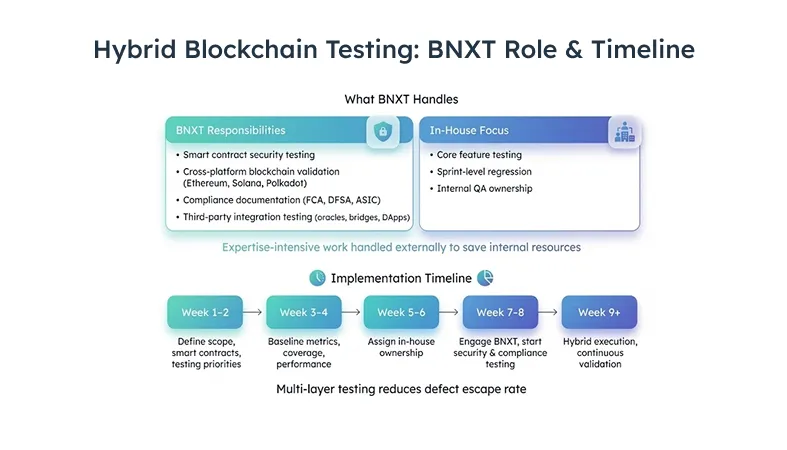
BNXT.ai specializes in blockchain testing services, exhausting in-house resources:
- Security-focused smart contract testing: Auditing for reentrancy, integer overflow, access control flaws, and gas optimization vulnerabilities.
- Cross-platform blockchain regression testing: Validating DApp across Ethereum, Solana, Polkadot, and other blockchain ecosystems.
- Compliance documentation: Generating testing reports satisfying UK FCA, UAE DFSA, and Australian ASIC requirements.
- Third-party integration testing: Testing smart contract interactions with oracles, bridges, liquidity pools, and decentralized applications.
In-house teams keep ownership of core feature testing and sprint-level regression. We handle expertise-intensive, compliance-critical work that diverts internal engineers from shipping features.
Implementation Timeline
Week 1-2: Define testing scope. Inventory smart contracts, identify blockchain security testing priorities, and map DApp user flows.
Week 3-4: Establish baseline metrics. Run initial blockchain functional testing to establish defect escape rate, smart contract coverage, and performance baselines.
Week 5-6: Assign in-house ownership. Designate which engineer owns blockchain regression testing, unit testing, and integration testing.
Week 7-8: Engage outsourced partner (BNXT). Share codebase, threat model, timeline. Outsourced blockchain QA team begins security testing and compliance audits in parallel with internal sprints.
Week 9+: Execute hybrid cycles. In-house team commits code. Outsourced blockchain testing validates security. In-house team runs regression testing. Defect escape rate drops because multiple verification layers catch bugs.
Decision Framework: Choosing Models
Five Questions to Answer
1. Launch timeline?
12+ weeks means in-house is viable. <12 weeks means outsourced blockchain testing wins (40% timeline compression).
2. Internal expertise?
Engineers with Solidity knowledge reduce ramp-up significantly. No expertise means outsourcing is mandatory.
3. Testing volume?
Startups need a <£10,000 monthly budget. Enterprise platforms need permanent in-house capacity.
4. Regulatory requirements?
Fintech platforms benefit from outsourced blockchain testing, documentation, and audit trails.
5. Multiple blockchains?
Ethereum-only sustains in-house expertise. Multi-chain teams need outsourced blockchain QA specialists.
How BNXT Evaluates
BNXT.ai delivers a 2-week diagnostic: assess codebase, audit current blockchain testing practices, and recommend in-house, outsourced, or hybrid models.
We don't force fit. Timeline and budget favor in-house? We design the team structure. Outsourcing blockchain testing makes sense? We onboard rapidly and scale with release cycles.
Conclusion
Outsourced blockchain testing wins for startups and compressed timelines. In-house testing wins for long-term cost and proprietary blockchain solutions. Hybrid models win for everything else.
Math is clearer than it seems: in-house and outsourced blockchain testing cost nearly identical amounts in year one. Year two, in-house costs drop, but team productivity climbs slowly. Outsourced blockchain QA costs hold steady while specialist quality stays high.
Time-to-market breaks the tie for most teams. DeFi protocol launching 8 weeks early captures millions in token value. That advantage alone justifies the outsourced blockchain testing cost.
A hybrid approach lets teams have both: in-house control over core features, outsourced blockchain testing expertise for security and compliance work that would otherwise delay launch or exceed budget.
Why BNXT.ai Is the Right Partner
BNXT.ai combines security-first smart contract testing with compliance documentation and rapid deployment. Blockchain testing services cover Solidity, Rust, Web3 frameworks across DeFi, NFT development, and cryptocurrency platforms. We work with teams, not around them. In-house engineers focus on shipping. We focus on preventing disasters.
Start with a 2-week scoping engagement. No long-term contracts. No vendor lock-in. Just clarity on which blockchain testing model works for business, and expert hands if outsourced or hybrid delivery is chosen. Schedule a consultation at bnxt.ai.
People Also Ask

1. What is the better ROI in-house or outsourced blockchain testing, and at what time?
Outsourced blockchain testing has a superior ROI to startups in 12 weeks or less. When teams develop proprietary smart contracts and have long-term, continuous testing needs, in-house testing is more cost-effective
2. What are the greatest risks associated with ROI in the case of selecting a blockchain testing model?
Among the in-house risks, there are slow ramp-up, costly hiring, and compounding costs of tooling. Among the risks that are outsourced are vendor lock-in, lack of internal knowledge transfer, and poor liability structures.
3. What is the impact of the time-to-market pressure on the ROI of blockchain testing?
The pressure related to time-to-market is the direct determinant of the ROI of outsourced blockchain testing. Every week of latency adds the cost of the lost early-user growth and token value. Outsourcing can generally help to reduce timelines by 4-8 weeks, which is a great ROI generator when faced with deadlines.
4. Under which circumstances do you advise a business not to develop an in-house blockchain testing team?
Under 12 weeks, lack of Solidity knowledge, and inconsistent volume of testing should cause avoidance of establishing an in-house blockchain testing team. Underutilized or temporary teams minimize ROI.
5. Does outsourcing blockchain testing jeopardize product security or compliance?
Outsourcing blockchain testing only undermines security when it comes to choosing the vendor. Qualified suppliers are certified, comply with the standards, and offer necessary compliance documentation, whereas cheap suppliers usually pose a threat.


.webp)
.webp)
.webp)

.webp)
.webp)