
.png)
Hybrid Cloud infrastructure unifies public cloud infrastructure, private cloud, and on-premises infrastructure resources to deliver flexible, historically controlled, and scalable computing environments. By appropriately managing all of these elements with an intelligent hybrid cloud management solution that offers centralised visibility, automation tools, quality management, and security tools to any of the distributed systems within a hybrid cloud infrastructure, organisations can benefit from the development of efficient hybrid clouds.
How the Hybrid Cloud Management depends on having a cloud management platform that has robust multi-cloud management, comprehensive cloud cost management, and Kubernetes support in order to be able to deliver performance metrics, compliance, and cost-effectiveness to organisations.
Understanding Hybrid Cloud Infrastructure
A hybrid cloud infrastructure is created with a combination of both public cloud infrastructure, private cloud environments, as well as on-premises infrastructure data centers as a single operational model for organisations to distribute their workloads in order to achieve the right balance of high performance, compliance, as well as cost-effectiveness, which are critical to any new cloud computing solution being developed today.
.webp)
This architecture is dependent on centralised orchestration through the use of Cloud Management Platforms (CMPs), strong Hybrid Cloud Management, and Integrated Multi Cloud Management capabilities. By utilising Hybrid Cloud Management tools and structured hybrid cloud data management, businesses will be able to attain scalable governance
Definition and Core Components of Hybrid Cloud Architecture
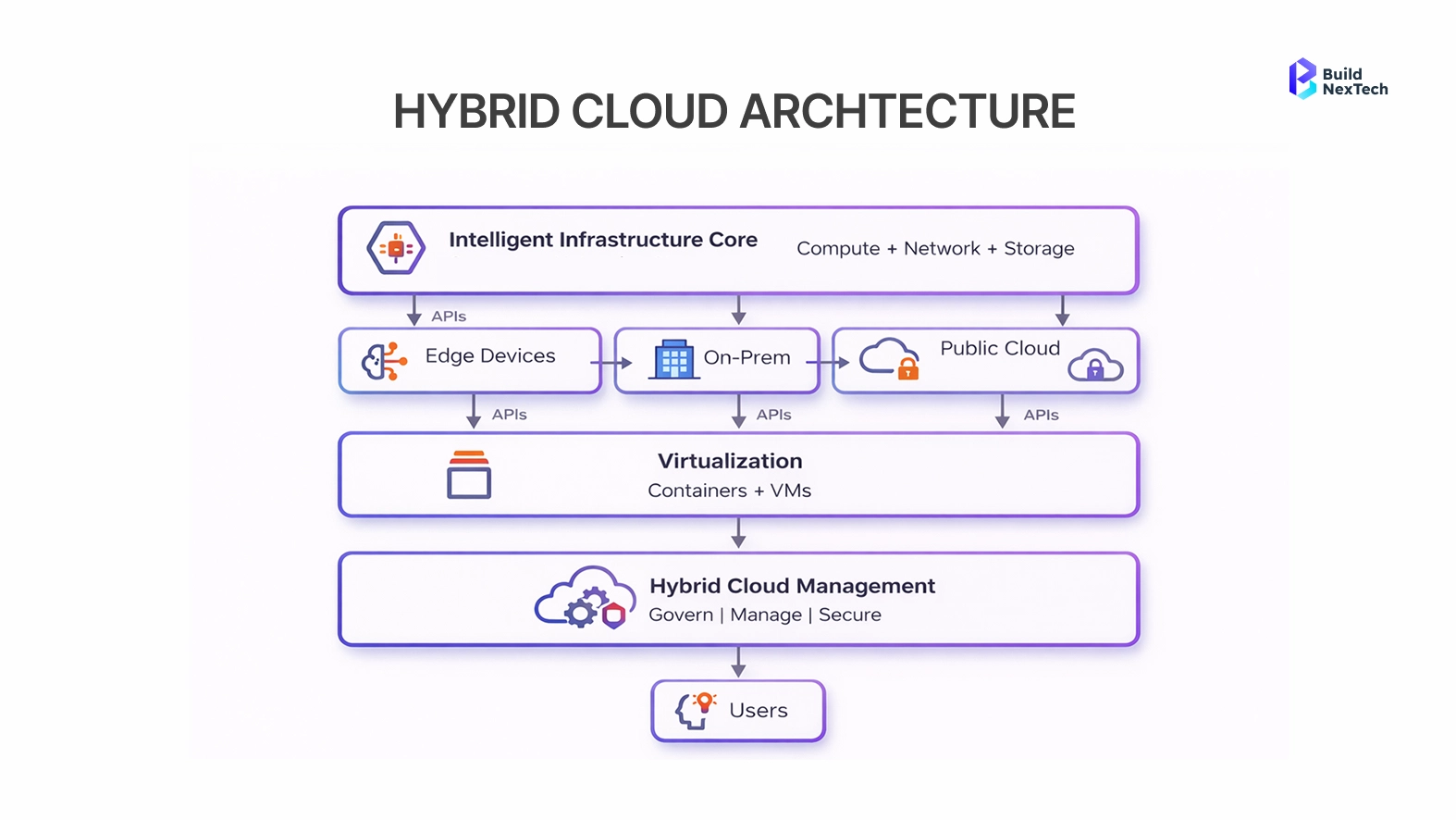
Hybrid Cloud Architecture combines public and private clouds to provide a seamless, flexible, and scalable infrastructure with centralized management. Key components include:
- Infrastructure Layer – Compute, storage, and networking resources, either on-premises or in the cloud.
- Public & Private Clouds – Integrated using platforms like AWS, Microsoft Azure, and Google Cloud, alongside private infrastructure.
- Cloud Management Platform (CMP) – Centralized control for provisioning, monitoring, and governance of hybrid resources.
- Automation & Orchestration – Tools for deploying and scaling workloads efficiently.
- Security & Data Management – User access control, data encryption, compliance, backups, and synchronization across hybrid environments.
Key Benefits of Hybrid Cloud Solutions for Enterprises
Businesses utilise hybrid clouds because of their flexibility, scalability, and stronger governance. Application modernisation occurs within the hybrid cloud while still being compliant, having control over where data resides and ensuring operational leading-edge capabilities.
Here are some of the benefits:
- Optimised placement of workloads to manage cloud-related costs during cloud migration
- Improved disaster recovery/business continuity capabilities
- Increased security due to the control companies have over their own private cloud environments
- Increased rates of innovation with the use of cloud-native services
- Unified management of all hybrid cloud-based data throughout all multi-cloud environments.
By using this methodology, highly regulated companies can maintain their balance of agility, performance and compliance while not losing control.
Common Challenges in Hybrid Cloud Management
The use of a hybrid cloud model complicates the management of operations without proper governance/centralised control regarding the cloud environment.
- The lack of cross-environment visibility might hinder the ability to perform efficient performance monitoring and make informed decisions.
- Poor policy enforcement inconsistencies create opportunities for security and compliance problems.
- Lack of effective cloud cost management generates difficulty with budget management and resource optimisation.
- Multi-Cloud Management fragmented services create operational silos.
- Utilising Integrated Hybrid Cloud Management systems helps bring together monitoring, security, automation and cost optimisation efforts.
Key Features to Look for in Hybrid Cloud Management Tools
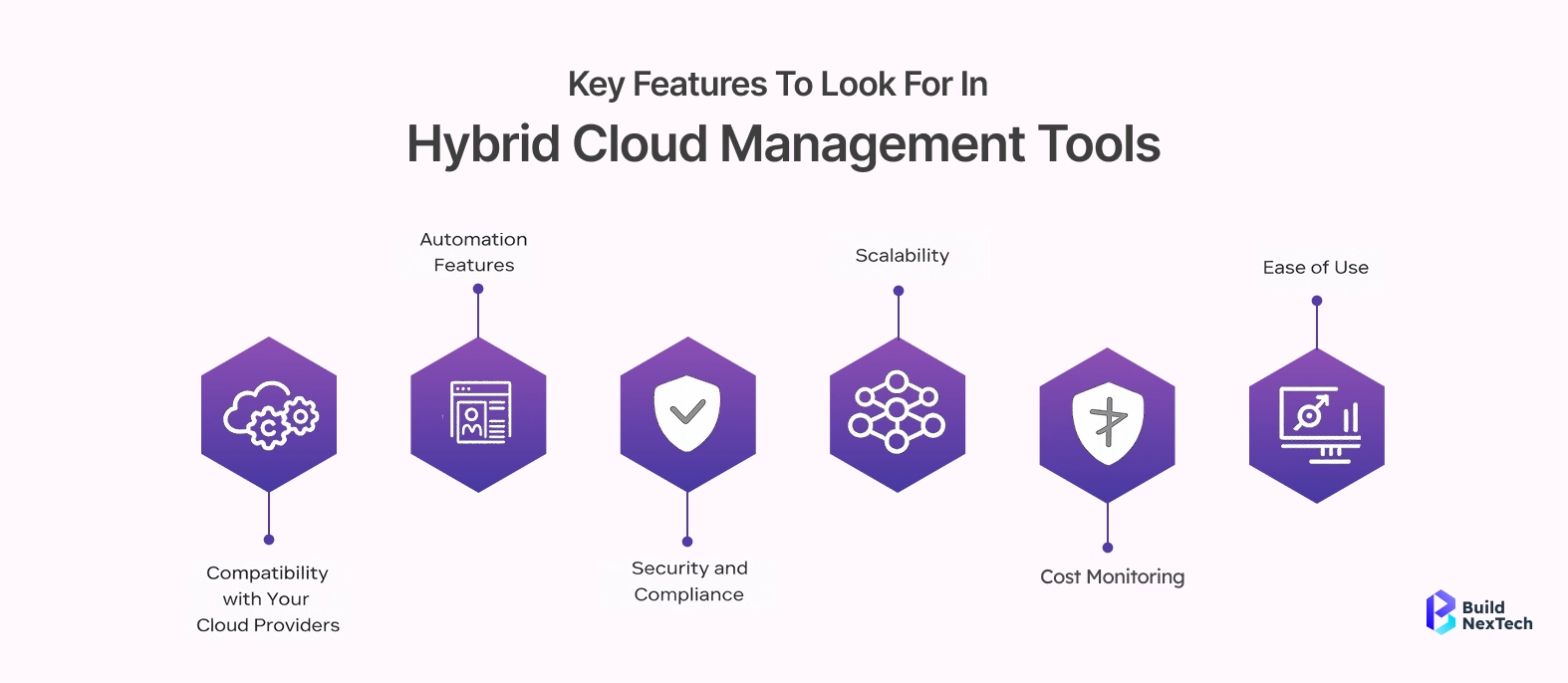
When selecting a hybrid cloud management tool, it's important to consider automation, scalability, security, and cloud governance as top priorities. The ideal cloud management platforms provide centralised monitoring, cross-cloud orchestration, integrated cloud cost control, and solid compliance controls, which help to manage hybrid cloud infrastructures easily; increase visibility; decrease technical debt over time; and enable digital transformation.
Integration, Automation, and Multi-Cloud Compatibility
Today’s infrastructure is distributed across several different clouds and on-premises, which is why managing multiple clouds is essential for visibility, control, and consistent operations. The need for integrated and scalable management solutions arises from distributing workloads for performance, cost-effectiveness, and compliance.
The key features of those solutions include:
- API-based integration with leading cloud providers to enable seamless connectivity
- (Automated) Efficient resource provisioning that replaces manual resources provisioning
- Policy-based scaling rules for both performance and cost optimisation.
- Support for open-source multi-cloud management platforms that eliminate vendor locks.
- Intelligent workload orchestration for optimised placement.
- Integrated monitoring and governance across all environments.
Organisations using structured multi-cloud management platforms will find they are more resilient to disruption and have increased operational agility as well as improved business continuity among distributed cloud environments.
Security, Governance, and Compliance Controls
Security is extremely important across hybrid and multi-cloud environments since sensitive data will be transferred across multiple distributed systems, each having to comply with local & global regulatory requirements. A solid governance model, visibility into data usage patterns and maintaining financial controls are essential components if an organisation desires to reduce risk while maintaining operational stability.
The major components of each working on a secure hybrid or multi-cloud environment should include:
- Role-based access control (RBAC) to manage user access to systems
- Encryption of data in transit and data at rest, including secure key management
- Automated compliance audits to ensure compliance with regulatory requirements
- Centralised governance dashboards to ensure consistent enforcement of policies
- Real-time threat detection, continuous monitoring of data and threat detection capabilities across all platforms.
Advanced cost management software can help organisations analyse their cloud (service) spending, forecast future trends, and create a budget that aligns cloud (service) spending with the company's overall hybrid cloud strategy and objectives.
Kubernetes and Container Management Capabilities
Cloud-native applications leverage Kubernetes for their container orchestration needs in a hybrid or multi-cloud context. In order to fulfil both requirements as a hybrid cloud tool must also provide the ability to have a centralised method to ensure both scalability and consistency.
Multi-cluster management, automated container scaling, cross-environment workload mobility, observability/monitoring, and secure CI/CD integration are critical capabilities of these tools.
Kubernetes-based solutions will improve deployment timing while also allowing increased security around managing hybrid cloud data, and providing consistent performance throughout distributed infrastructures.
Types of Hybrid Cloud Management Tools
Hybrid cloud environments span many different types of infrastructures and thus require many different types of management tools to manage the complexity, provide governance, and optimise performance.
There is no one-size-fits-all solution that meets all of an organisation’s operational requirements, and as such, many organisations adopt an assortment of management tools that form a layered strategy for achieving their management objectives regarding their hybrid cloud infrastructure. Collectively, the various types of tools represent a unified hybrid cloud management framework that helps improve security, lower costs, and increase agility for enterprises that utilise multiple clouds.
Cloud Management Platforms (CMPs)
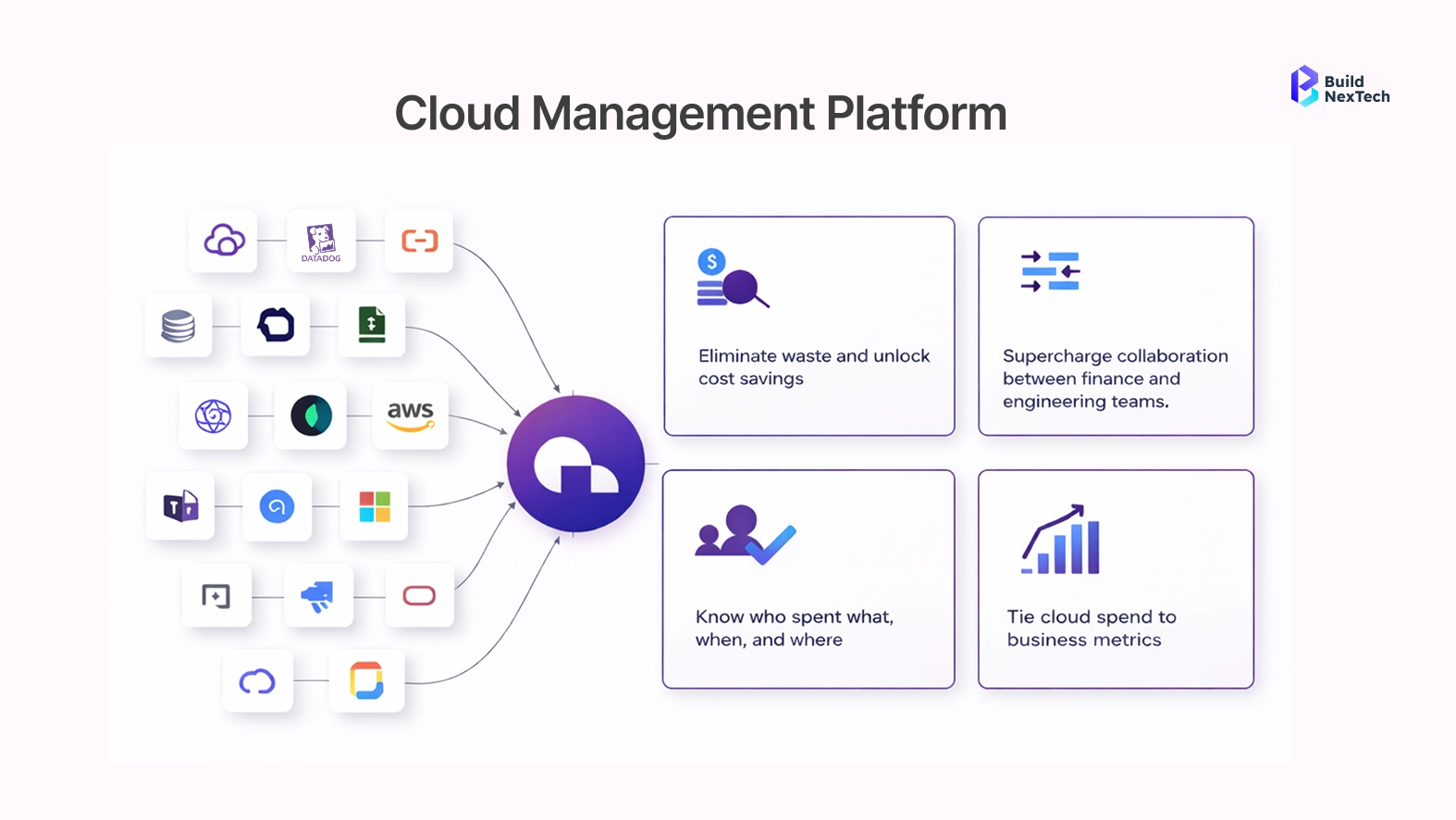
The Cloud Management Platform serves as a single point of control for managing the Hybrid and Multi-cloud environments.
- Performance Monitoring Across All Cloud Environments
- Automated Workload Orchestration
- Integrated Cloud Cost Management Capability
- Compliance & Governance Reporting
- Resource Utilisation Analytics
Through a single interface, the Cloud Management Platform consolidates multiple cloud
management toolsets together to reduce administrative workload while providing an improved level of visibility into the enterprise.
Multi Cloud Management Tools and Platforms
Multi-Cloud management tools continue to see increasing adoption worldwide, due to an ever-evolving range of cloud providers and the growing number of businesses operating in a multi-cloud environment.
Among the most important features of multi-cloud management tools are:
- Cross-platform analytics dashboards that provide consolidated view of all clouds, including historical and real-time performance information.
- Cost forecasting capabilities that provide advanced projections of expected costs, as well as budgeting and optimisation analysis.
- Unified API integration capabilities that enable seamless connection and management of multiple disparate cloud providers.
- Flexible deployment options that allow organisations to deploy multi-cloud management services in multiple different deployment scenarios (on-premises, SaaS, hybrid), based on their individual enterprise infrastructure strategy.
By utilising a structured approach to managing multiple clouds, organisations can create an environment that promotes resilience and independence from vendor(s). Additionally, this approach facilitates long-term growth and innovation.
Kubernetes-Centric Hybrid Cloud Tools
Kubernetes-specific tools aid organisations develop and manage containers within hybrid clouds and multiple locations, through one central orchestration tool providing automation for both container based environments. Cluster monitoring tools provide current information on how clusters are performing and allow you to automatically enforce policies to ensure security and compliance.
DevOps provides an integrated deployment process that speeds the available of applications by providing performance optimisation and built in security scanning as part of the application build process, and provide a pathway to modernising your legacy systems in distributed environments.
Evaluating Hybrid Cloud Management Software
When choosing the best hybrid cloud management solution, it is essential to undertake a structured evaluation of performance, scalability, and vendor support. Some of the aspects to look for are, intuitive user interface, support for real-time analytics, and the ability to support multiple infrastructures to facilitate operations, as well as ensure continued growth.
Documentation from the vendor and evidence that their solution has been adopted by many organisations. A thorough evaluation will help to ensure that you can successfully implement and maintain hybrid cloud management services while reducing risk to your organisation.
User Experience and Interface Design
- Usability in interface design helps users quickly and easily adopt a platform. Usable Interface Design also increases operational efficiency for a company.
- Customisable dashboards give teams the ability to customise team views to their own business and technical requirements.
- Role-based access views provide segmented/permission based security and visibility to users within their assigned roles.
- Automation configuration tools provide the ability to automatically configure and operate workloads without requiring manual effort on the part of the user.
- Clear visualisation of performance will enable faster troubleshooting and better decision making by the user.
- Good cloud platform management tools help simplify the complexity of cloud services so that teams can focus on innovation and not on resolving routine maintenance issues.
Scalability and Performance Optimisation
For hybrid cloud environments, scalability (adaptability) of infrastructure to changing workloads is essential for long-term success and should not adversely affect performance, security, and cost efficiency.
Some key capabilities related to scalable infrastructure include:
- Elastic resource allocation
- AI-based performance balancing
- Proactive monitoring alerts
- Predictive capacity planning
- Integration with cloud cost management tools
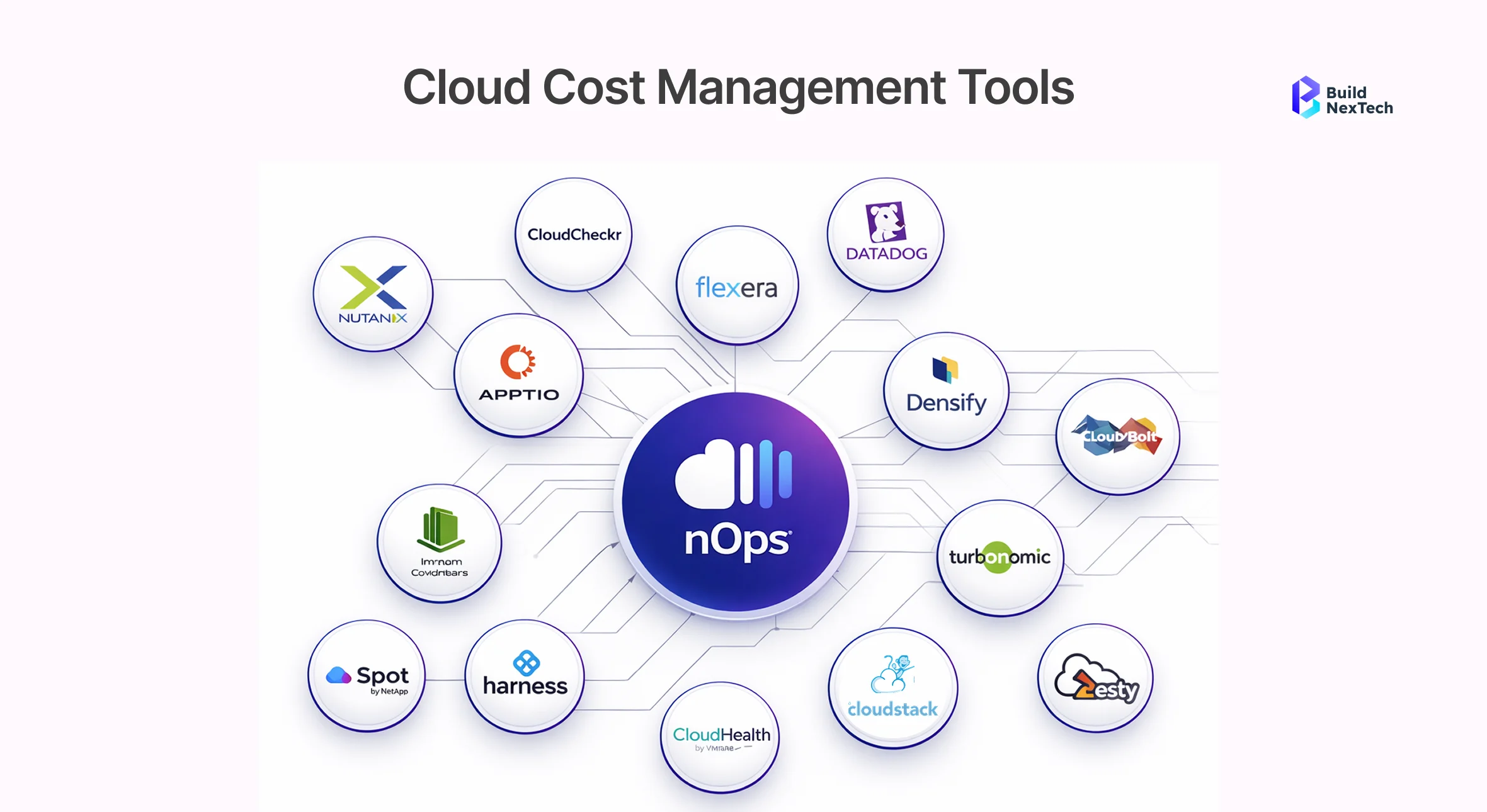
Optimised scalability leads to improved control of costs, operational resiliency, and business continuity in continually evolving enterprise cloud ecosystems.
Vendor Support and Documentation
- Having technical support available at all times, along with detailed documentation, provides assistance in resolving problems quickly and adopting the platform smoothly.
- The ability to participate in training programs combined with knowledge of compliance requirements in the various geographic areas where one operates allows companies to manage and align their governance and regulatory responsibilities better.
- Innovation from the community, through collaboration with others, leads to continually improving products or services provided by the vendor's ecosystem.
- Vendors such as Amazon Web Services (AWS) or Microsoft Azure offer large global support networks; this also increases confidence that your hybrid cloud management software investment is secure.
Key Platform Capabilities Driving Efficient Hybrid Cloud Operations
Modern hybrid cloud platforms bring together visibility, automation, cost governance, and security into a unified ecosystem. By centralising control across public and private environments, they enable intelligent workload orchestration, real-time performance monitoring, and optimised resource allocation.
These capabilities help enterprises reduce operational complexity, control cloud spending, strengthen compliance, and scale infrastructure efficiently while maintaining performance and resilience.
Unified Multi-Cloud Visibility and Centralised Control
- bnxt.ai delivers complete visibility across multi-cloud and hybrid environments through real-time performance monitoring and centralised control.
- Automated policy enforcement strengthens governance and compliance, while intelligent workload recommendations optimise resource allocation and efficiency. Cross-region analytics provide insights into infrastructure health and scalability.
- By consolidating monitoring, automation, and control into a single platform, bnxt.ai improves operational efficiency and reduces risk.
- Unified reporting dashboards that provide leadership with clear, actionable insights across cloud environments for better strategic decision-making.
Advanced Cost Monitoring, Optimisation, and Automation
Effective cost control is critical in hybrid and multi-cloud environments due to complex, variable workloads. bnxt.ai addresses this with integrated cloud cost management tools that balance innovation with financial governance.
Key features include:
- Budget forecasting and tracking with real-time visibility by department or project.
- AI-driven optimisation to right-size resources and eliminate idle workloads.
- Automated scaling policies aligned with budget and performance targets.
- Detailed financial reporting supporting chargeback or showback models.
- Granular usage analytics across compute, storage, and network resources.
By combining performance monitoring, automation, and cost governance, bnxt.ai enables enterprises to reduce waste, maximise ROI, and scale efficiently.
Built-in Security, Compliance, and Kubernetes Support
- Access in hybrid and multi-cloud environments is secured through role-based access control (RBAC), ensuring users only access approved resources. Automated compliance audits continuously monitor adherence to regulatory and organisational policies, reducing risk and enforcement effort.
- Secure workload migration enables safe transfer of applications and data across public and private clouds, while centralised Kubernetes management ensures secure control of containerised workloads. Data in transit is encrypted end-to-end to maintain confidentiality and integrity.
- bnxt.ai optimises hybrid cloud data management, strengthens operational resilience, and supports secure, compliant enterprise cloud services.
Conclusion
Enterprise IT is evolving with Hybrid Cloud Infrastructure, allowing organisations to use both public and private cloud resources for better flexibility and scalability. This approach helps businesses modernise systems while maintaining control and performance.
Hybrid Cloud Management (HCM) and Cloud Management Platforms (CMPs) bring all cloud resources into one central view. With better monitoring and workload management, organisations can improve visibility and operate more efficiently across environments.
Cloud Cost Management (CCM) helps control spending through smarter resource usage and automation. By adopting a balanced hybrid cloud strategy, businesses can improve efficiency and reduce costs. Exploring the right platform today can help build a simpler, smarter cloud foundation for tomorrow.
How BNXT Helps in Managing Hybrid Cloud Environments
Intelligent hybrid cloud solutions from bnxt.ai combine automation, governance and analytics into an integrated platform. Solution features include centralised multi-cloud dashboards; advanced cloud cost management, AI-powered performance optimisation; integrated Kubernetes orchestration; and automated compliance enforcement.
bnxt.ai assists companies with transforming disjointed infrastructures into scalable, secured and effectively managed hybrid-cloud ecosystem
People Also Ask

1)What are the benefits of hybrid cloud management?
Reduces costs, improves resource utilization, and streamlines operations through automation and centralised control.
2️)How does hybrid cloud enhance efficiency?
Automates processes, provides unified monitoring, and minimizes manual tasks.
3️)What risks come with hybrid cloud environments?
Security, compliance, and integration challenges can arise without proper governance. Complexity may lead to operational inefficiencies.
4️)How does hybrid cloud support business continuity?
Through workload portability, disaster recovery, and multi-region redundancy. It ensures applications remain available during failures.
5️)How long does hybrid cloud implementation take?
Typically a few weeks to several months depending on complexity and scale. Phased deployment minimises disruption and accelerates adoption.


.webp)
.webp)
.webp)

.webp)
.webp)