

Svelte 5 is a current-day JavaScript framework aimed at making frontend development simple by reducing components to highly optimised JavaScript code, instead of using a virtual DOM. Compared to most of the user interface frameworks, Svelte 5 pushes the work to compile time, which leads to a smaller bundle size, fewer side effects, and rapid web applications.
Svelte 5 has a smooth reactivity model, enhanced reactive programming functions, enhanced state management patterns, and enhanced TypeScript integration into Professional Web Development patterns. The Svelte framework is regarded by many developers as a development of lightweight, high-performance web application development.
We will discuss Svelte 5 in this blog in both beginner and real-world implementation perspectives, such as:
- The difference between Svelte 5 and the conventional method of using JavaScript frameworks, and why its reactivity model enhances the productivity of developers.
- The tutorial on how to configure a first development environment of Svelte 5 with the help of modern tooling.
- An in-depth examination of components, reactive state, lifecycle hooks, and event processing in practice.
- Live examples of the use of Svelte 5 in performance-oriented web apps and production-ready applications.
- An overview of how Svelte 5 compares to other frontend development frameworks to aid in your decision on when it is the correct choice.
In case your business has its own plans to create high-performance web applications that are modern or wants to migrate to Svelte 5 to build scalable frontends, BuildNexTech is a company that plans to assist you in designing, developing, and implementing Svelte-powered solutions specific to your project. Get in touch with our team.
Introduction to Svelte and What’s New in Svelte 5
Svelte 5 is a significant advancement to the Svelte framework, with its performance-focused refinements and a more robust reactivity model without compromising the philosophy of being lightweight. This passage details how Svelte functions at the hood, what distinguishes it among the other frontend frameworks, and the major improvements that are made in Svelte 5 that enhance developer experience, scalability, and real-world use in modern web applications.
What Is Svelte and How It Works
Svelte 5 compiles component code directly into highly efficient JavaScript modules, removing the need for a virtual DOM and runtime diffing. Instead of relying on tree comparisons to manage reactive state updates, Svelte responds to changes through reactive primitives and reactive assignments. This design makes application logic easier to understand, improves runtime performance, and minimizes unintended side effects in modern web applications.
- Generates optimized JavaScript output without virtual DOM overhead
- Updates reactive state through primitives and assignments rather than diffing trees
- Improves performance and simplifies state management logic
- Reduces unexpected side effects in complex frontend applications
- Commonly used for building web applications, single-page applications (SPAs), and progressive web apps (PWAs)
- Actively adopted within frontend developer communities such as the r/sveltejs Subreddit
- Supported and referenced by professional platforms including TechLink Hub, PixelFree Studio, MDN Web Docs, and O’Reilly Media
Key Changes and Improvements in Svelte 5
The major improvements in Svelte 5 are:
- More complete support of component props and component bindings.
- Better lifecycle hooking in side effects management.
- New file-based routing and routing system patterns through Svelte Kit.
- Improved the construction and generated static sites.
- Better Context API and API routes support.
- Developed a hot module replacement that is more reliable.
These enhancements are often discussed by thought leaders like Rich Harris and in community forums, as well as in Svelte framework learning resources.
Setting Up Your First Svelte Development Environment
Svelte 5 opens the frontend, whether you are writing a small Svelte application, a Svelte website, or your entire web application framework is going into production.
Svelte Development Tools and Requirements.
Tools and Prerequisites for Svelte Development
To begin working with Svelte 5 and Svelte Kit, you’ll need:
- Node.js and a modern CLI tool
- An extension of Svelte to VS Code (highly recommended)
- The fundamental knowledge of JavaScript code and JavaScript modules.
- Optional: Docker container configuration of deployment workflows.
To style, a developer may utilize scoped CSS, scoped styling, Tailwind CSS, or conventional CSS files, all of which are well-supported in Svelte UI projects. Building optimisation by configuring Vite Svelte files and Vite config files is also popular amongst many professional Svelte developers.
Creating Your First Svelte 5 App with Vite
You can quickly scaffold and run your first Svelte 5 project using Vite and the CLI tool. Follow these key steps and concepts:
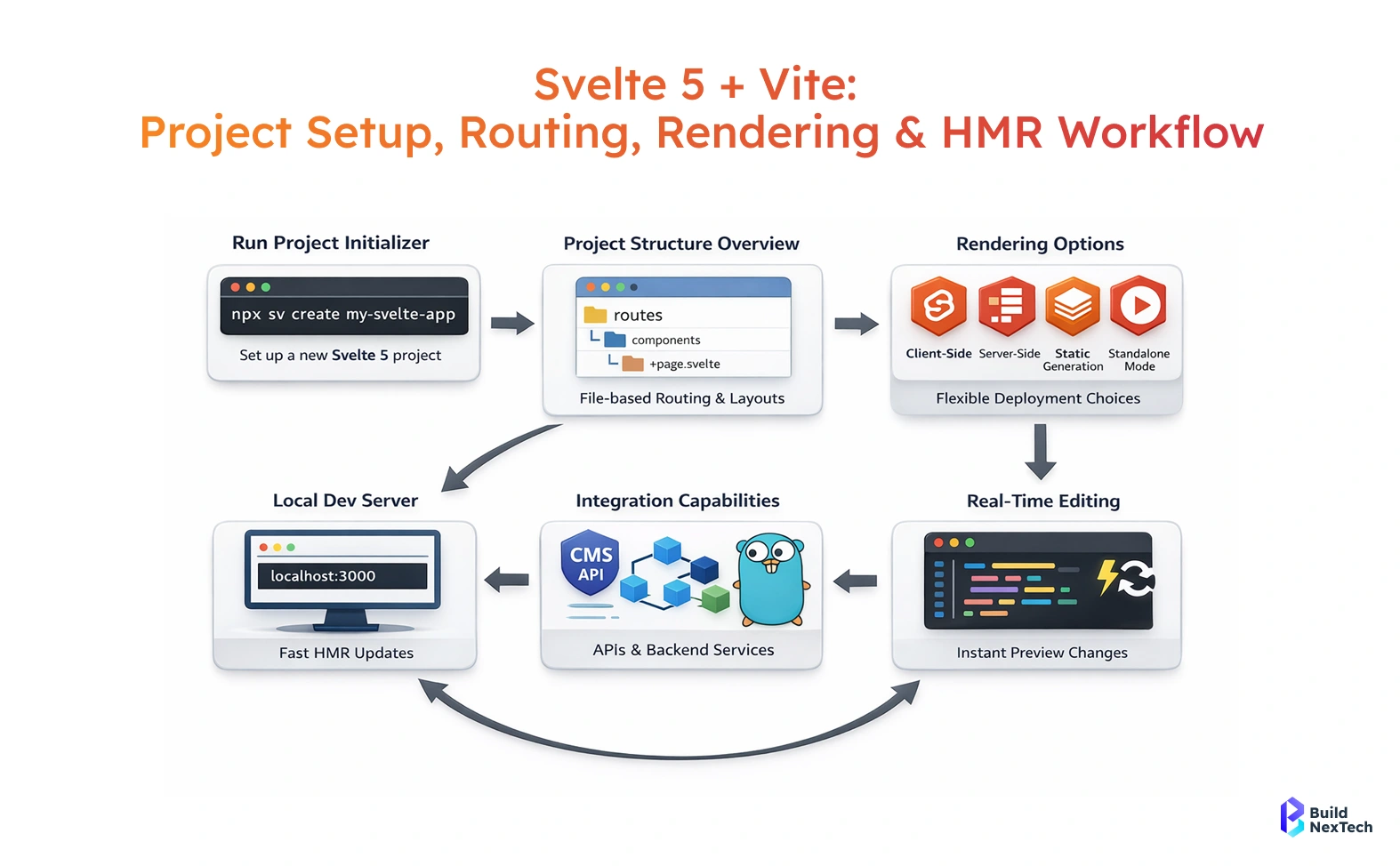
- Run the project initializer
Use the command below to create a new project:
- What the npx sv create command does
- Generates a fresh Svelte 5 project setup
- Includes svelte-kit for development and routing
- Enables file-based router and routing library features
- Automatically configures a local server environment
- Explore the project structure after setup
- Review the file-based routing folders
- Understand how routes map to pages automatically
- Check how layouts and components are organized
- Rendering and deployment flexibility
Svelte 5 lets you choose between:- client-side rendering
- server-side rendering
- static site generation
- standalone mode development
- Fast developer experience with HMR
- Hot module replacement allows real-time updates
- Edit component directives and component code
- Changes appear instantly without refreshing
- Integration capabilities for real-world projects
Svelte projects can work seamlessly with:- CMS APIs and API routes
- microservices patterns
- Go library or backend services
- Custom web application development workflows
npx sv create my-svelte-app
Understanding Svelte 5 Components and Reactivity
Svelte 5 proposes an honest reactivity model that is readable and simplifies reactive programming and state management, as well as deep reactivity.
Component Structure, Syntax, and File Layout
An example of a Svelte 5 component contains:
- JavaScript code and a reactive primitive script block.
- Markup of component prop and special element.
- CSS scoped styles or scoped styling.
Svelte component bindings have two-way data flows, and lifecycle hooking deals with side effects in initialisation and tear-down. Context API provides shared reactive state functionality between components - can be used in larger web applications and web development frameworks.
Reactivity, State, and Event Handling in Svelte 5
Svelte 5 has simple reactive assignment patterns in place of complex layers of state management. State libraries are unnecessary unless the developers want state libraries.
Key advantages include:
- Pure event management of component properties.
- Form and UI logic, Natural deep reactivity
- Integration of the routing system.
- Older Svelte version projects or Svelte JavaScript projects can be debugged and migrated more easily.
Svelte 5 has lower overhead when compared to Angular frontend or Angular 10ish tools. Though Angular Signals was based on elements of the Svelte reactivity model, the Svelte language remains committed to a minimal bundle size and explicit Svelte programming. This renders Svelte a good rival to frontend frameworks, including React frontend, Vue frontend framework, and other web development companies that consider it the most suitable frontend framework.
Real-World Use Cases for Svelte
Svelte 5 is a suitable fit for both start-up prototypes and enterprise-scale web applications, which is why it can be incorporated as a practical solution in any of the teams interested in high-performance, smaller bundle size outputs, and efficient handling of reactive state in modern web applications. The lightweight architecture and compile-time optimisation model make it specifically relevant in those environments where speed, scalability, and readable JavaScript code are important.
When to Use Svelte for Production Applications
Svelte is ideal for:
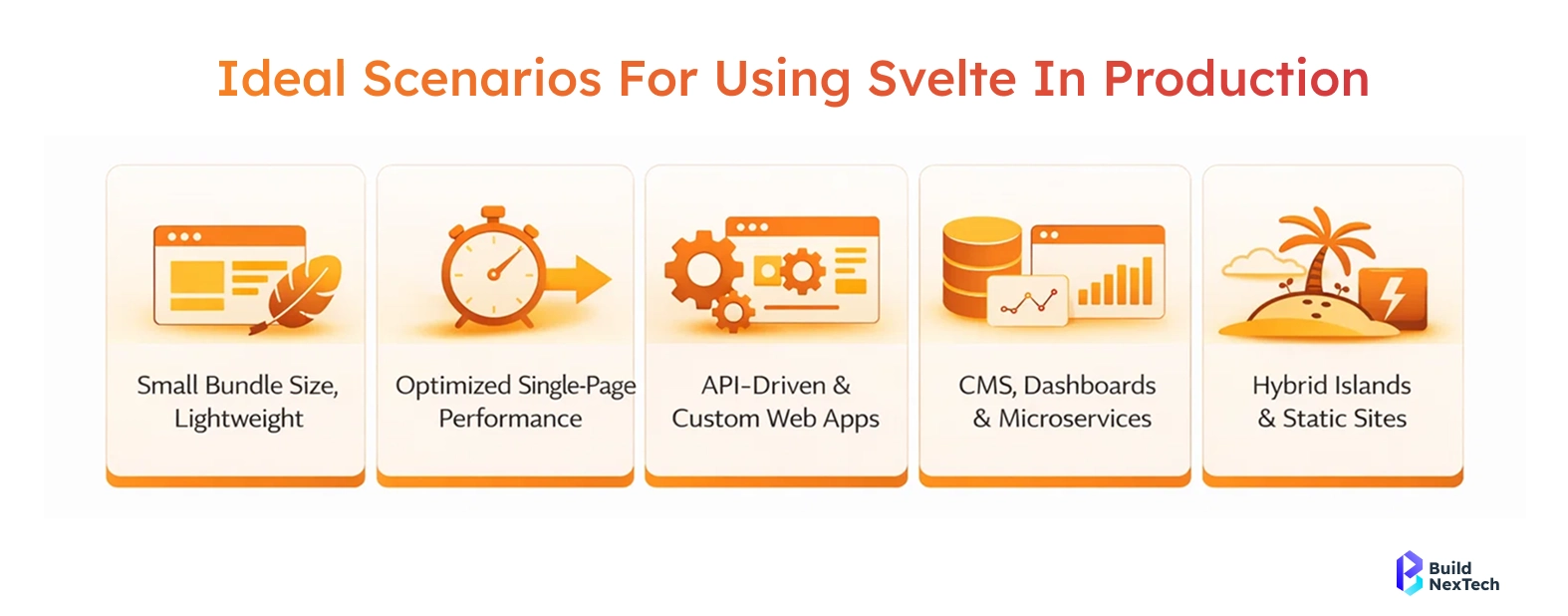
- Small bundle size, Lightweight web applications.
- The performance optimisation of single-page applications.
- Individual web applications development using API Testing support procedures.
- APIs of CMS, dashboards of notification settings, and microservice patterns.
- Architecture: The architecture of hybrid islands and projects for generating static sites.
Most web development agency teams and web development companies use the Svelte framework when building reactive state-performance Web Development pipelines.
Companies Using Svelte in Real-World Products
- Square (Block inc.) - Cash app Web Experiences.
The Square has implemented Svelte 5 and the Svelte framework in some aspects of its dashboard and reporting interface in web apps.
They chose Svelte for:
- Reduced the size of bundles and a reduction in load time.
- Performance of a reactive state with no massive state management libraries.
- Smaller and readable JavaScript code and reduced side effects during use.
The engineering team also claimed that there was smoother UI rendering than the traditional approaches based on the virtual DOM.
- Spotify Data Dashboards and Internal Tools.
Svelte is used by Spotify engineering teams to build internal analytics dashboards and UI utilities used to support frontend development workflows.
They prefer Svelte because:
- Prototyping is more speedy with the reactivity model.
- Deep reactivity minimizes boilerplate as compared to other JavaScript framework tools.
- Their lightweight tools architecture would be good with a static site generation and client-side rendering option.
The small size of the Svelte bundle helps enhance the performance of internal web applications that are used at an international scale.
- The New York Times- Interactive News Features.
Svelte has been utilized in the interactive storytelling elements and data-focused visuals created by the New York Times, which is posted on their site.
The reasons why they chose Svelte are:
- It is used to provide high-performance graphics rendering of graphics-intensive content.
- Supports scoped styling, component bindings of modular layouts.
- Makes deployment of one-off interactive aspects without massive frameworks.
The outcome is the faster loading of interaction pages driven by minimum JavaScript modules.
Svelte for High-Performance and Lightweight Web Apps
Svelte performs well in environments where performance and responsiveness are vital, such as:
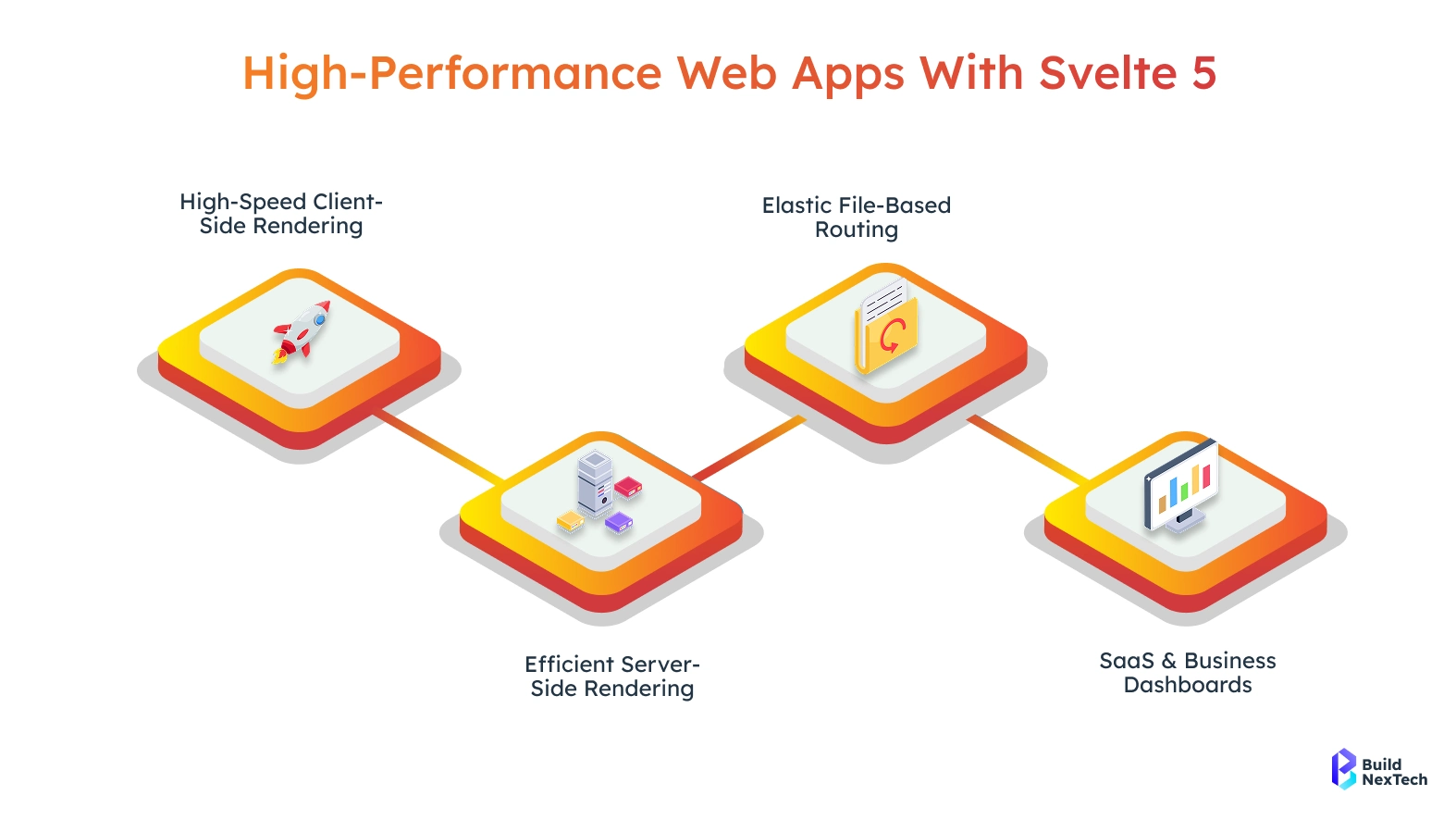
- Client-side rendering at high speed.
- Svelte-Kit-based server-side rendering is efficient.
- Elastic routing library and router architecture on file.
- SaaS, analytics, business dashboards, and Svelte frontend products.
Svelte developers often run to Docker containers, add AI book helpers, train code context explainers, and work together in communities like Svelte Developer Interview Questions and TechLink Hub learning portals - contributing to the rising presence in the current frontend development ecosystems.
Svelte vs Other Frontend Frameworks
Svelte 5 is usually contrasted to such frameworks as React, Vue, or Angular, and its compile-time-based approach and smaller bundle sizes render it fundamentally different. This part points out how Svelte 5 compares to other frontend frameworks in terms of performance, reactivity, and the experience of building it.
Svelte vs React, Vue, and Angular
Svelte 5 is fast and excels at performance-striking web app development, particularly when the goals are lightweight architecture and working with minimal side effects.
Is Svelte the Right Choice for Your Next Project?
Choose Svelte 5 if you want:
- Faster builds, optimised bundle size, and deep reactivity
- Simple component bindings and lifecycle hooks
- Clean routing system and file-based routing
- Strong support for custom web development services and website development services
A professional web development company or website development agency can help plan large-scale Svelte implementations and enterprise-grade web application development.
Conclusion
Svelte 5 provides a promising performance, simplicity, and modern Web Development functionality. Having robust model support in reactivity, in-built state management, a wide-ranging routing system choice, and idealized workflows related to site generation and server-side individualizing, Svelte 5 emphasizes itself as a visionary Svelte framework for production web applications.
In addition to its technical leverage, Svelte 5 also makes teams create cleaner JavaScript code, decrease the bottlenecks of bundle size, and side effects of complex web apps. Its lightweight architecture and reactivity model, it a viable option to developers who would like to have a fast performance but do not compromise on scalability and maintainability.
Whether you are developing a Svelte website, Svelte application, or a Svelte frontend-based enterprise project, BuildNexTech is ready to design, code, and deliver high-performance Svelte 5-based solutions that will meet your business requirements. We will create your next Svelte project.
People Also Ask

Is Svelte 5 backward compatible with older Svelte projects?
Yes, migration scripts and documentation resources help ensure smoother transitions between earlier Svelte.js versions and Svelte 5.
Does Svelte 5 support TypeScript out of the box?
Yes, TypeScript integration is officially supported and commonly used in professional Web Development workflows.
How stable is Svelte 5 compared to other frontend frameworks?
Svelte 5 is production-ready and widely adopted in web development companies and web development agencies worldwide.
What are the limitations of using Svelte for large-scale applications?
Large apps may still rely on layered state management or routing library extensions; however, the Svelte framework continues to evolve.
Is Svelte 5 suitable for enterprise-level web applications?
Yes, especially when paired with expert implementation from a custom web development services team or website development company.


.webp)
.webp)
.webp)

.webp)
.webp)