
.png)
Three years back, generative AI was on the watchlist, but not the roadmap, of most CFOs. Nowadays such discussions conclude with the shortlists of vendors and schedules of rollout. This is not simply because of the improved tools, generative AI has unlocked whole businesses that were not profitable previously.
In this blog, we explore how generative AI is creating new industries, how enterprises are adopting it, and the infrastructure required to scale it successfully.
Understanding Generative AI
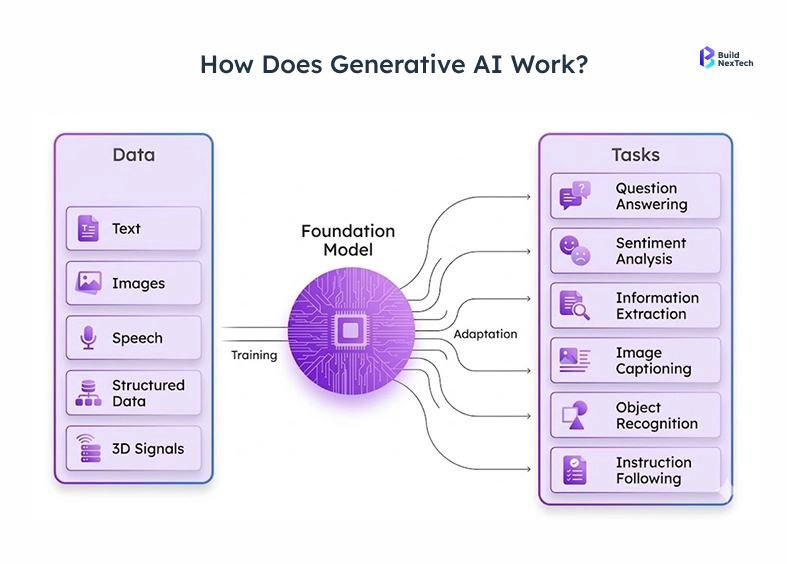
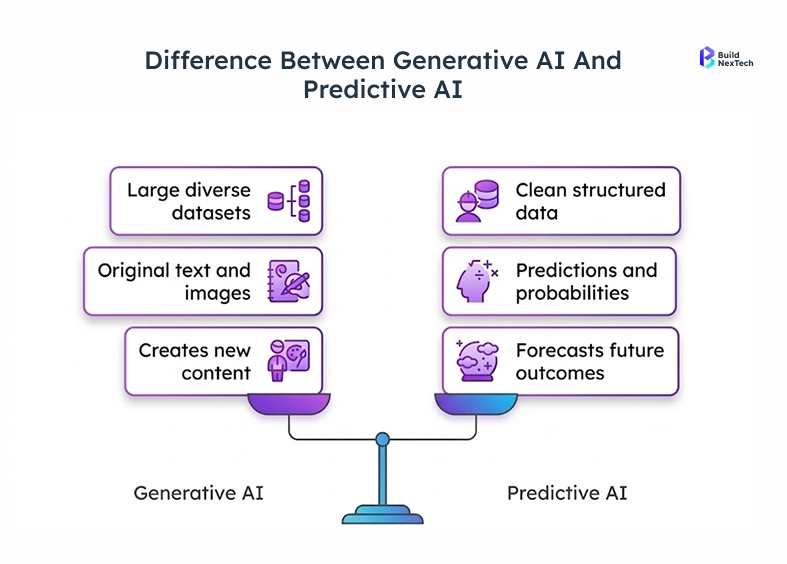
Generative artificial intelligence refers to AI systems that create new content—such as text, images, audio, video, or code—by learning patterns from large datasets. This differs from predictive AI, which analyzes existing data to forecast outcomes. Instead of simply predicting results, generative AI can produce outputs like drafted contracts, working code, or summaries of customer interactions based on past data.
Important technologies governing the modern genAI:
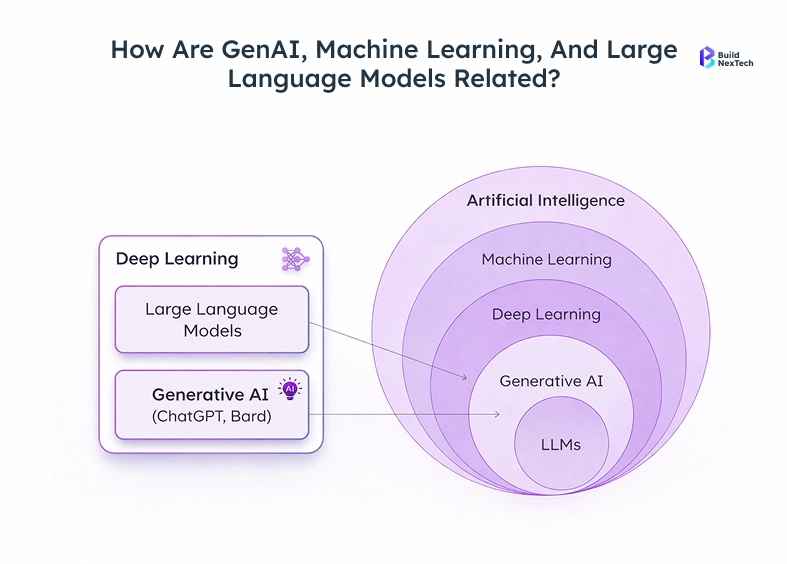
- The current generation of text-based AI app tools is built on large language models (LLMs) that are trained on large datasets of internet content.
- Natural language processing (NLP) enables AI systems to understand context, generate human-like responses, and support multilingual interactions in enterprise applications.
- Image generation models that use diffusion models include Stable Diffusion and DALL-E 3.
- Modern generative AI systems combine large language models, machine learning techniques, and multimodal capabilities to generate text, images, and structured outputs.
The consumer-facing products based on these are models such as GPT-4, Claude, Gemini, DALL-E 3 and Stable Diffusion. The foundational research work, on which most of what corporations now roll out, is being done by Google DeepMind, Anthropic, and OpenAI.
How B2B Companies Are Using Generative AI Right Now
The applications that passed the pilot phase have in common one feature, namely, structured, high-volume workflows where occasional AI errors are tolerable. That is where it is being played out in industries:
Software and Development Enterprise wide: productivity benefits beyond typing speed:
- GitHub Copilot is used by over 1.3 million developers daily—not for experimentation, but in real production environments.
- The time spent on boilerplate by engineers reduces and the time on architecture decisions where actual judgments need to be made are increased.
Customer Service and Support Automation: at which tier-1 queues are being substituted by AI-driven customer support agents:
- Multilingual virtual assistants now handle common queries across chat, email, and voice channels more effectively than before.
- According to customer service teams that apply AI, first-response time, and workload of a support team decrease significantly.
- There is no end to the automation of the customer journey, as complex cases are enforced on humans, however, with increased speed and documentation.
Supply Chains and predictive analytics: AI in charge of doing the work:
- McKinsey estimates that generative AI could automate up to 30% of business activities across occupations by 2030.
- Inventory management systems analyze real-time demand signals and supplier variables
- The same predictive analytics infrastructure of drug discovery and clinical decision-making in life sciences is based on predictive analytics.
Content Generation and Decision Intelligence: accelerated scale and structural analysis:
- Decision intelligence platforms uncover findings and results of huge data sets within minutes-- formerly an analyst task.
- According to McKinsey & Company, generative AI could add between $2.6 trillion and $4.4 trillion annually to the global economy, with productivity gains across use cases estimated in the 15–40% range.
Many enterprises are adopting generative AI by integrating machine learning, NLP, and automation into their existing platforms.
Generative AI and the Rise of New Industries
The most interesting part of the generative AI story is the industries it's building from scratch — categories that have gone from zero to attracting serious capital in under five years.
AI-Powered Creative Industries
Generative AI has significantly reduced the time required for creative work, but it has also developed other forms of businesses that were previously not in commercial demand.
Synthetic Data Platforms - training data solver in regulated industries:
- AI models need training data. That data in industries like healthcare, finance, and autonomous systems, data is often sensitive, scarce, or both.
- Synthetic data vendors create fake datasets, which resemble real data in their statistical characteristics but not actual data.
- Gretel.ai is aimed at companies that require privacy-guaranteed training information; These solutions are widely used in regulated industries like financial services.
AI-Native Content and Media - the boundary between the user of tools and AI-native business is getting indistinct:
- New platforms that are designed to support AI-assisted script writing, music generation and visual generation.
- Scalable content generation is now provided by business: descriptions of products, variant ads, assets localized to dozens of markets simultaneously.
- The new model of agencies retains human creators in terms of strategy and quality assurance but leaves the AI to take care of the amounts of iteration.
Generative AI in Business and Enterprise
There have been three enterprise markets which generative AI basically brought into existence:
AI Infrastructure Providers - bridging gaps left by traditional hyperscalers
- It takes tens of millions of GPU compute to train a frontier model - only few organizations can afford to do so.
- Infrastructure designed by CoreWeave, Lambda Labs, and Together AI were optimized on AI workloads, which were faster than AWS and Azure on the demands of AI teams.
- Autonomous vehicles, smart cities, and enterprise processes are becoming increasingly dependent on purpose-built compute infrastructure as AI absorption operations go massive.
AI Safety and Red-Teaming Services - is now a mandatory purchase, not a luxury:
- To implement AI within the organization, it is important to assess the likelihood of its risks prior to its implementation and not after a breach.
- Red-teaming companies verify that it produces harmful outputs, hallucinatory, training data bias, jailbreak, and data security breaches.
- We have already witnessed the emergence of AI red-teaming being a formal requirement in enterprise RFPs, which were not referencing it two years ago.
AI Workflow automation Platforms - winning by doing one thing well:
- Glean is a searchable internal knowledge-search business, Moveworks automates IT and HR workflow, Harvey is a legal work company, and Ironclad is a contract management firm.
- Enterprise contracts are won on such platforms not by claiming the finest feature range.
How Businesses Are Adopting Generative AI
The adoption of enterprise AI follows a series of familiar steps - and most organizations are further on than the external communications indicate.
The majority of companies have passed the initial phase: providing the generative AI tools to employees and observing the consequences. Certain teams practiced it, whilst others disregarded it. This step generates valuable signals but has low chances of generating ROI in itself.
The second phase of AI implementation which consists of integrating it with particular work processes that have established quality rules is where the majority of mid-market businesses find themselves. Actual productivity increases begin to be realized, yet it demands redesigning of process, identification of products ownership, and feedback mechanisms to detect mistakes.
The third level is the creation of products that could not be there without AI as a component part. The organizations that do make it always did it similarly: they ingested AI in a limited number of workflows they have instead of applying it in a way that is thin across all activities.
The zone between stage two and stage three is the one where the majority of AI deployment plans already get stalled because of the data infrastructure that does not yet exist, the governance policy that has not yet been finalized, and the organizational desire to, in fact, re-design workflow rather than add AI to it.
Organizations exploring enterprise AI adoption often start by implementing enterprise generative AI solutions that integrate automation, data analysis, and intelligent decision-making into business workflows.
Enterprise Use Cases of Generative AI
Cases that have the best ROI in production currently:
- Document generation: drafting contracts, compliance reports, and regulatory filings.
- Supply chain management and inventory optimization - predictive analytics identify changing demand and supplier risks before turning into operational issues.
- Insight and analysis decision intelligence - convert big data into organised decisions in seconds compared to the time it can take a human analyst to handle.
- Generate content, scale, e.g., local marketing content, product descriptions, dozens of ad variants, in dozens of different markets at the same time.
Generative AI as a Competitive Advantage
Many vendors claim generative AI creates competitive advantage. As soon as the same models are accessed by all companies using the same APIs, the models do not distinguish anybody. Access is not an advantage.
There are three things that a subscription cannot imitate that give real benefit:
- Training data that is proprietary i.e. a model trained on your customer history and domain will perform better on your own niche use-cases than generic artificial intelligence.
- Deep workflow integration - AI implemented on a process basis alters unit economics that cannot be easily duplicated by competitors; it takes months and requires actual organization change.
- Gradually increasing speed of iteration - It is speed of AI deployment development that is as fast as possible and improves as time passes more gradually with growing speed of market reaction.
Enterprise Infrastructure for Generative AI
It is always observed that organizations do not underestimate any requirement of AI production. It is one thing to have a proof of concept on a small number of documents, and another to be able to issue 50,000 queries a day with latency of less than a second, data security conditions and compliance audits. What proved good at the former scale can easily fail at the latter.
Infrastructure Required for Generative AI
- Compute: GPU clusters for training and inference; this is hardware, it has constant demand, exceeding supply quite frequently, making lead times significant compared to most teams.
- Data pipelines - aggregation, cleaning, and formatting training data on a large scale; nearly always the most time-intensive element of the stack.
- Production-volume latency-controlled load balancing APIs, model serving infrastructures.
- Data security and access controls - Do not allow sensitive information to be released via model output, API reply or logs, the Cybersecurity and Infrastructure Security Agency has issued specific guidance on the security of AI deployment, and most enterprise groups use it when reviewing their architecture.
Enterprises building AI-powered applications often invest in domain-specific models and scalable infrastructure to support production use cases.
Generative AI vs Predictive AI in Business
- Predictive AI will enhance the quality of decisions - fraud detection, demand forecasting, predictive maintenance, clinical decision-making - ROI will be realized in downstream results.
- Generative AI yields some outputs, documents, code, analyses, content generation, ROI is reflected on the number of labor hours saved or more output generated.
- The decision intelligence platforms are a combination of both: predictive analytics shows where we should give attention, and generative AI is the output that takes action on such signals.
Challenges and Considerations
Those obstacles exist and are brushed over during vendor discussions. Most of them have been experienced in organizations that have scaled AI deployments, with the ones that did not prepare the deployments being the slowest and most costly.
Ethical Implications of Generative AI
Prejudice and Equality - a danger not of tomorrow, of today:
- Historical biases are reproduced by models that are trained on historical data - every model that is deployed contains historical biases.
- Biased outputs lead to severe legal and reputational risks in the context of hiring, lending, triage in healthcare, and criminal justice.
- The solution is systematic output audits, and human accountability over the consequences of decisions, rather than the aversion to AI.
Hallucination - one of its essential properties, not a bug under repair:
- LLMs write confidently, well-written erroneous responses, - architectural, and repairing in a later release.
- RAG (retrieval-augmented generation) outputs in verified source documents minimises but does not eradicate risk.
Data Security and IP — two unsettled exposures:
- The transmission of controlled information to third party APIs results in compliance risk - this is the way the majority of regulated businesses do it.
- Cybersecurity and Infrastructure Security Agency has highlighted AI as a rising attack surface that has to be secured with particular security architecture.
Labor market and ethical considerations — already in motion:
- The effect of AI deployment on jobs is more often discussed in the media, legal, and tech worker organization and collective bargaining.
- Open discussion with groups regarding the effects of AI on their activities cannot be an extravagance; it is responsible deployment.
.webp)
The Future of Generative AI
- Models will become cheaper and more able - cost per token is down by a massive percentage and it is not showing signs of stagnating.
- Multi-step autonomous actions of agentic AI systems will shift from experimentation to production of customer service, supply chains, and decision intelligence processes.
- The multimodal models that operate with text, image, audio, and video will be common in intelligent cities, self-driving cars, or clinical decision-making systems.
- Regulation and AI policy are coming of age - companies that are designing AI-ready compliance infrastructure today have fewer impediments to regulation landing.
Conclusion
Generative AI is not just improving productivity - it is creating entirely new markets, from synthetic data platforms to AI infrastructure and enterprise automation systems. A new type of an industry is being generated with the assistance of machine learning, big data, and deep learning technology amalgamation.
Preparing Businesses for an AI-Driven Future
- Build strong data infrastructure in advance of selecting models - bad data with good models give bad results.
- Policy writing governance and ethical considerations should be done prior to the use of AI and not after an incident.
- Grow on 2-3 processes - customer service, inventory handling, content creation - before going enterprise wide.
- Outcome measures, not activity - before/after measures are better than a tool installed on AI.
- Reconsider data security, Terms of Use, and year-one compliance requirements.
How BuildNexTech Can Help
BuildNexTech collaborates with enterprise teams working on infrastructure and implementation issues that will result in an AI pilot project turning into a production system - or becoming a shelf-warmer in half a year. We work across:
- Training data infrastructure and data pipeline architecture.
- Application to regulated industries where data security is needed and there is a need to deploy the private model.
- AI workflows in the areas of customer service, content generation, decision intelligence, and supply chain applications.
- Governance models and ethical frameworks are implemented proactively—not after deployment.
When you are caught in between experimentation and production - when running into data preparedness, compliance, or redesigning workflow problems - that is precisely what we solve.
People Also Ask

1. How is generative AI accelerating the growth of the AI economy?
Generative AI increases productivity and enables entirely new markets. Goldman Sachs estimates it could add $7 trillion to global GDP, while McKinsey reports 15–40% productivity gains for knowledge workers.
2. What new industries are emerging because of generative AI?
New sectors include synthetic data platforms, AI infrastructure providers, and AI safety services. Companies like Scale AI, CoreWeave, and Gretel.ai support AI training data, compute infrastructure, and enterprise AI deployment.
3. How are enterprises integrating generative AI into their business operations?
Enterprises use generative AI for customer service, content creation, and workflow automation. Many organizations focus on improving a few high-value workflows to achieve measurable ROI.
4. What infrastructure is required to support large-scale generative AI systems?
Large-scale AI systems require GPU computing, scalable data pipelines, and secure cloud infrastructure. Strong data governance and security frameworks are also necessary for enterprise deployment.
5. What are the biggest challenges businesses face when adopting generative AI?
Key challenges include data readiness, hallucination risks, governance policies, and data security concerns. Organizations must also manage regulatory compliance and workforce impacts.


.webp)
.webp)
.webp)

.webp)
.webp)