

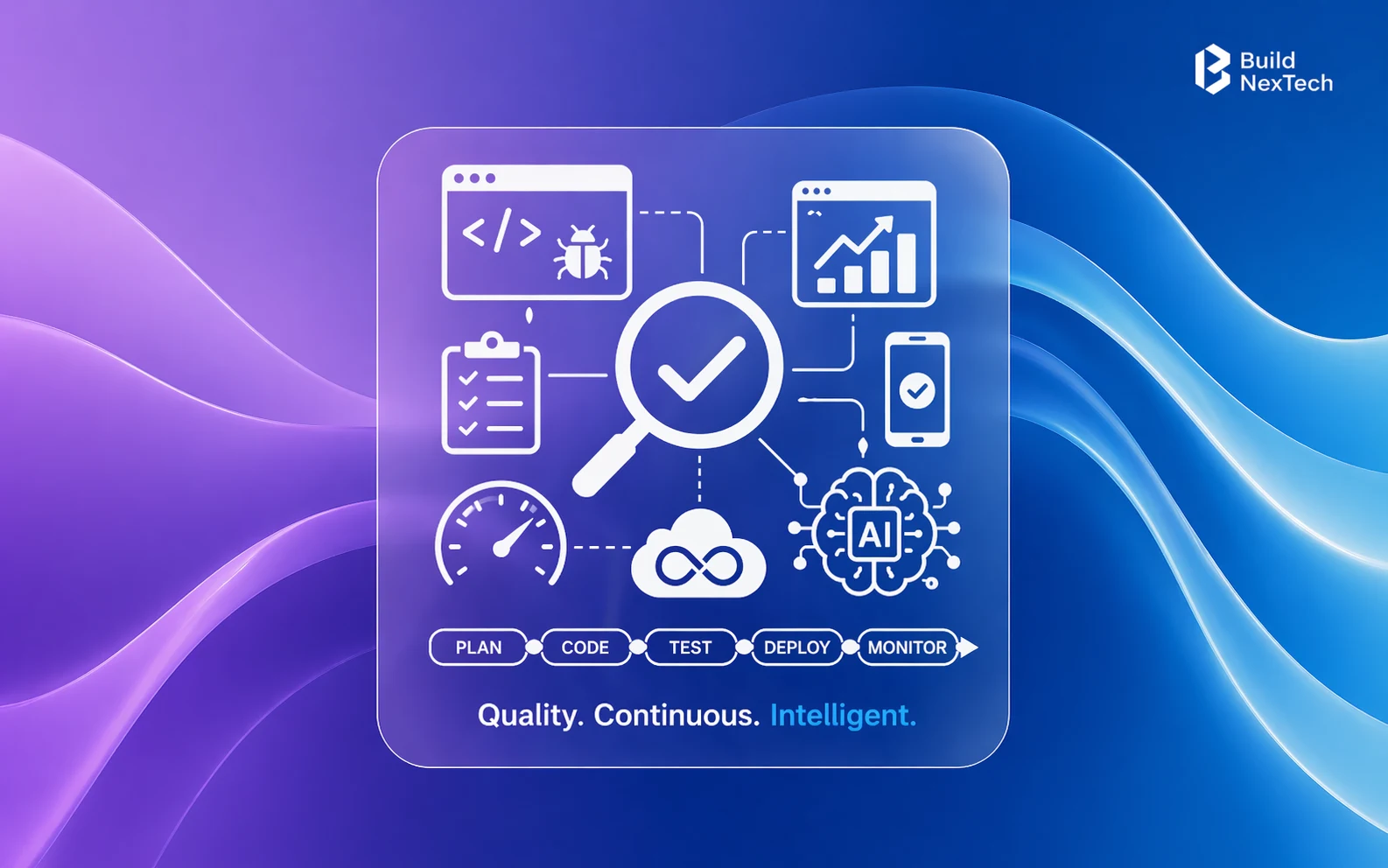
Software testing has changed a lot - but not in the way most teams expect. The fundamentals haven't gone anywhere. What's changed is the scale of what you're expected to test, the speed at which you're expected to test it, and the consequences of getting it wrong.
A decade ago, a QA team could sit at the end of a development cycle, run a suite of manual testing checks, file some bugs, and call it done. That model doesn't hold anymore. Not when you're deploying five times a day into DevOps pipelines. Not when your system is a constellation of microservices, microfrontend architectures, and distributed Cloud SaaS infrastructure. Not when a single performance regression can quietly drain revenue for weeks before anyone notices.
This guide covers the core building blocks - what they are, why they matter, and where modern software testing services are heading.
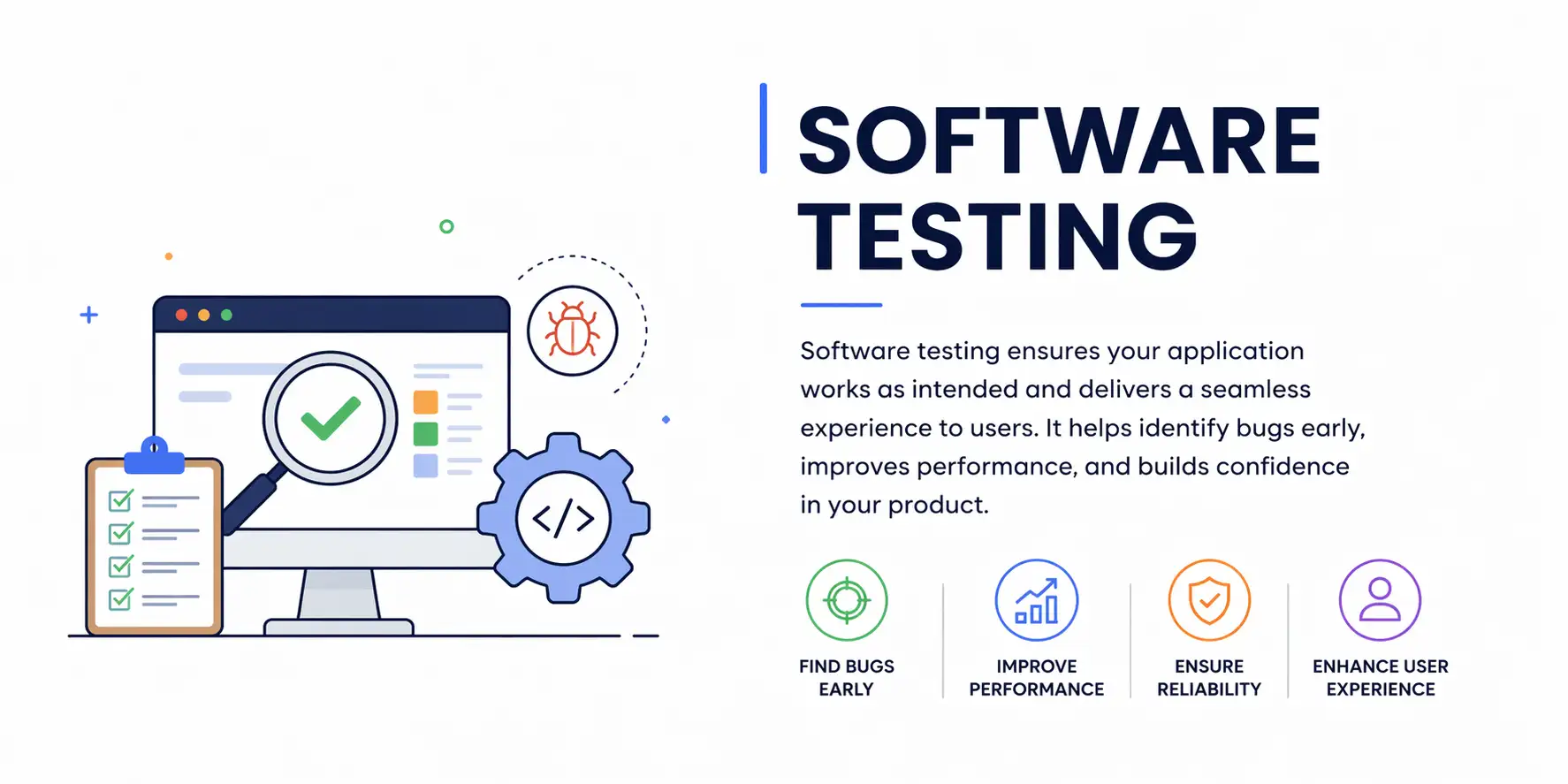
What Software Testing Actually Covers Now
The textbook definition still holds: software testing validates that a system meets its functional and non-functional requirements. But the scope of "requirements" has expanded considerably over the last few years.
Today, a complete testing strategy - one you'd expect from any serious software quality assurance function - needs to cover:
- Functional correctness: does the software behave as specified?
- Integration behavior: do the components work correctly together, including third-party APIs and services?
- Performance under load: does the system hold up when traffic spikes or data volumes grow?
- Security posture: is user data protected? Are you compliant with HIPAA and PCI DSS requirements?
- User experience consistency: does the application work correctly for every user, on every device, across browsers?
- Code quality: are changes introducing hidden complexity that will compound into future bugs?
None of these is optional if you're building software real users depend on. And all of them sit inside the broader discipline of continuous quality engineering - an approach that treats quality not as a gate at the end of development, but as something maintained throughout it.
Core Testing Types - and Why Each One Matters
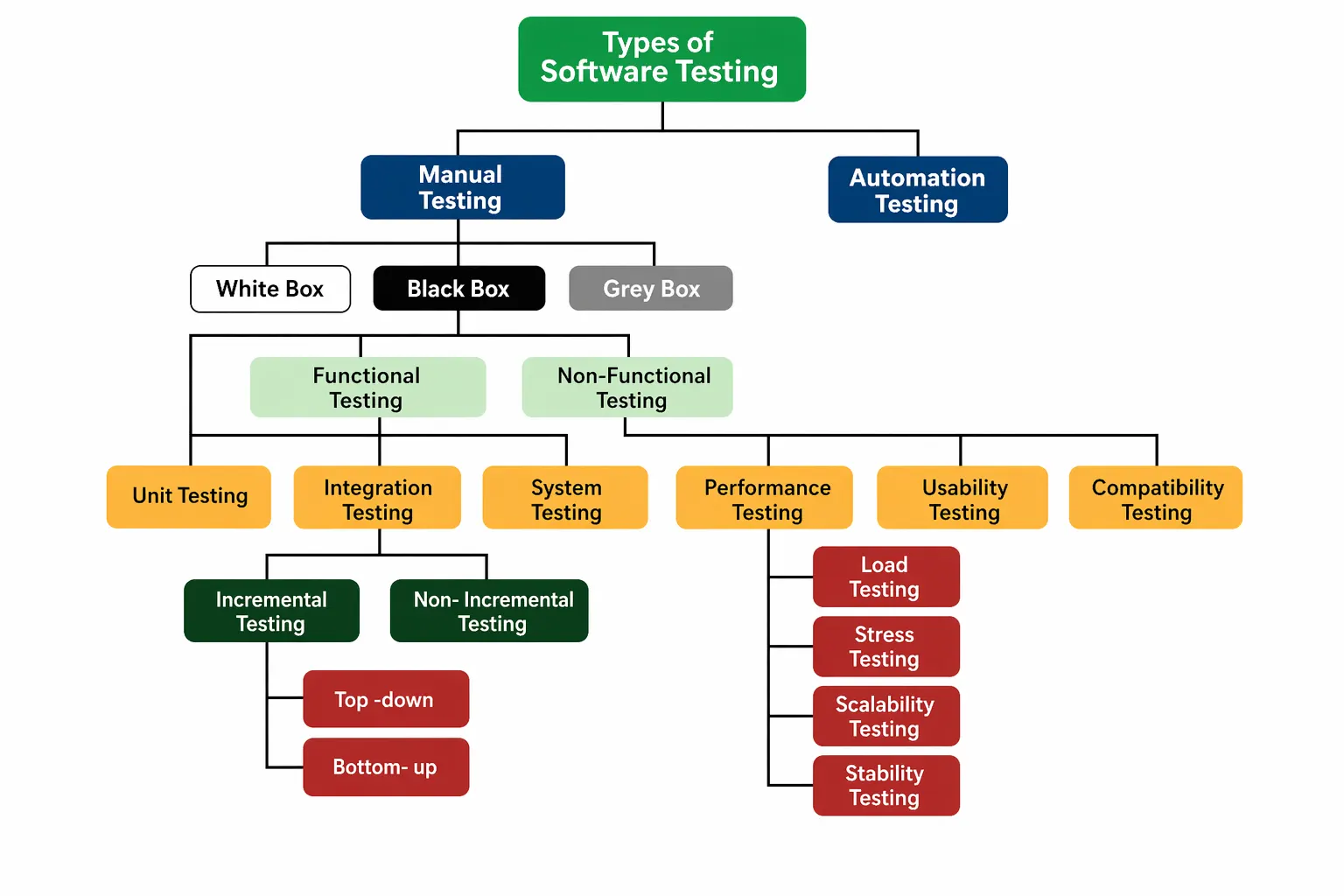
Functional Testing
Functional testing validates behavior against requirements. It includes unit testing at the component level, integration testing across modules, API testing for endpoint correctness and data flow, and user acceptance testing (UAT) to confirm the software meets business expectations.
A well-maintained Requirements Traceability Matrix helps QA engineers map test cases to specific requirements, which makes coverage gaps visible and keeps audits manageable - especially in regulated environments.
Unit testing catches problems at the smallest possible scope. A single function, a single module. Fast to run, cheap to maintain, and the first line of defense against regressions. Most teams know they should write more of these than they actually do.
Integration testing checks whether components behave correctly when connected. This is where a lot of bugs actually live - not in the individual pieces, but in the assumptions each piece makes about the others. Microservices architectures amplify this: more services means more integration surfaces, and more places for things to break silently.
API testing has become more important as systems move toward service-oriented design. If your API contract changes without warning, everything downstream breaks with it. Testing endpoints, validating API keys, checking error handling, and confirming data formats should be part of every release cycle - not an afterthought. The OpenAPI Specification is an industry-standard reference for defining and validating API contracts.
User acceptance testing is still irreplaceable for anything with significant UX complexity. Automation tools don't catch everything. A real user clicking through a flow will surface issues that no automated testing script anticipated.
Non-Functional Testing
Non-functional testing covers the "how well" rather than the "what." It's where performance testing, security testing, accessibility testing, and cross-browser testing live.
Performance testing and performance engineering are often skipped until something goes wrong. That's backwards. A SaaS app that passes all functional tests can still collapse under real traffic if load testing was never run seriously. Performance and load testing in staging environments is a lot cheaper than diagnosing a production incident. Tools like Apache JMeter and k6 are widely adopted for this layer.
Security testing services cover a range of attack surfaces: static analysis, dependency scanning, penetration testing, and threat modeling. With cyber threats growing in sophistication, treating security testing as a checkbox exercise is a genuine risk. For teams building on Cloud SaaS, IoT analytics platforms, or systems that process sensitive financial data, a layered security testing approach is table stakes. The OWASP Testing Guide remains the go-to reference for security testing methodology.
Accessibility testing ensures the software works for users with disabilities - screen readers, keyboard navigation, contrast ratios. Beyond compliance with WCAG 2.2 guidelines, it's a code quality issue. Inaccessible UIs are usually a symptom of brittle UI element structures that cause problems elsewhere too.
Cross-browser testing catches rendering and behavior inconsistencies that individual developer environments miss. With the diversity of browsers and devices in real-world user experience, this matters more than teams typically budget for.
Advanced Testing Approaches
Regression testing confirms that new changes don't break existing functionality. Regression testing services are most valuable when automated - running a full regression suite manually before every release is slow and error-prone.
Exploratory testing is the one type that genuinely requires human judgment. A skilled QA professional working through an application without a fixed script will find edge cases that no test plan anticipated. It complements automation rather than competing with it.
End-to-end testing validates complete user flows across the full stack - from the frontend through the backend, databases, and any third-party integrations. These tests are expensive to maintain, which is why the test pyramid recommends keeping them focused on the most critical paths.
Shift-left testing moves testing earlier in the development cycle - into design and code review, not just pre-release. The practical effect is that bugs get caught when the context is fresh and the fix is cheap. Shift-left is less a specific tool than an organizational decision to stop treating QA as a phase that happens after development is "done." According to IBM's Systems Sciences Institute, fixing a bug in production can cost up to 30x more than catching it during design.
Manual Testing vs. Test Automation
Manual testing services remain essential for exploratory scenarios, UAT, and usability evaluation. But if your team is still running regression suites manually before every release, you're working too hard and moving too slowly.
Test automation with tools like Selenium WebDriver, Cypress, and Playwright makes it practical to cover large regression surfaces at speed. A solid test automation framework gives you reliable continuous delivery - every commit validated, every feature branch checked before it merges.
The maintenance cost is real, and flaky tests are a genuine drain on QA engineers' time. Dynamic waits help with timing-sensitive UI element interactions that otherwise produce inconsistent results. But neither maintenance overhead nor flakiness is a reason to avoid automation - they're engineering problems to solve, not arguments for staying manual.
Practical split: test automation handles speed and coverage. Manual testing services handle judgment, exploration, and the scenarios too complex or too rare to automate economically.
Test Environments and Test Data Management
You can have excellent test scripts and still get unreliable results if your test environment doesn't reflect production. This is more common than most teams admit.
Staging environments drift from production. Test data becomes stale. Preview environments get used for development work and end up in inconsistent states. Services get updated in production but not in staging. The result is tests that pass in CI but fail in production - or worse, tests that pass everywhere but don't catch real issues because the conditions don't match.
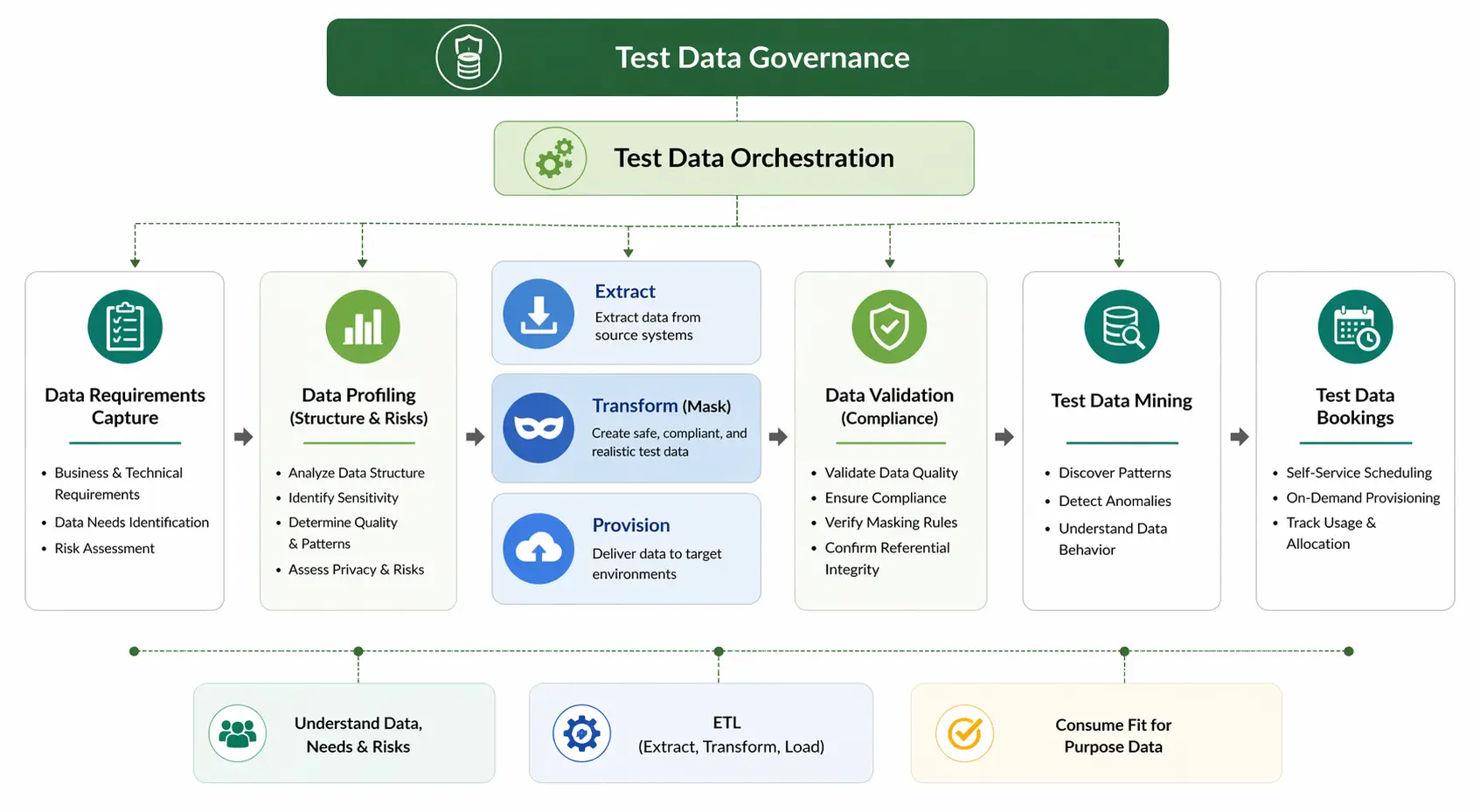
Test data management is one of the highest-leverage investments a QA team can make. Synthetic data generation helps - particularly for systems where using real production data in testing creates HIPAA or PCI DSS compliance risk. Reliable test data provisioning through structured synthetic data sets means your tests run against realistic conditions consistently, not just when someone remembered to refresh the database.
For healthcare software development and fintech applications, this isn't optional - it's a regulatory requirement.
Testing in CI/CD Pipelines
Continuous testing services make testing a permanent part of development rather than a gate at the end. Every commit triggers automated testing. Every feature branch gets validated before it merges. Deployment gates catch regressions before they reach users.
The benefit is real: shorter feedback loops mean developers catch bugs when the code is still fresh. The challenge is that this only works if your test suites are fast, reliable, and well-maintained. A CI/CD pipeline full of flaky tests doesn't prevent bugs - it just generates noise until developers start ignoring the results.
This is where continuous delivery and continuous quality engineering intersect. Popular CI/CD platforms like GitHub Actions and GitLab CI make it straightforward to integrate testing gates directly into your delivery workflow. The goal isn't just to automate testing - it's to make the feedback fast enough that fixing a bug is never a two-week archaeology project.
Challenges QA Professionals Actually Face
The tools available to QA professionals today are genuinely good. The problems are usually not the tools.
Flaky test suites are the most common complaint. Tests that pass on one run and fail on the next erode trust in automation and slow down releases. Root causes vary - environment inconsistency, timing issues with dynamic UI elements, brittle selectors - but the pattern is consistent.
Coverage gaps in microservices architectures are hard to detect. Individual services look fine in isolation. Interoperability testing across the full system surfaces the integration assumptions that nobody documented.
Test scenario explosion happens as systems grow. More features, more edge cases, more combinations to check. Without a clear prioritization strategy, test suites grow faster than teams can maintain them.
Flaky staging environments undermine confidence in test results. A failed test that turns out to be an environment issue rather than a real bug wastes debugging time and trains teams to distrust their own pipeline.
None of these problems are solved by adopting a new tool. They're solved by investing in test infrastructure, test data management, and clear ownership of test quality. Our software quality engineering team regularly helps engineering organizations untangle exactly these patterns.
Where AI Testing Fits
AI-powered testing is genuinely useful in some areas and overhyped in others. Worth being specific.
Self-healing test scripts that adapt automatically to UI changes reduce the maintenance burden in test suites that would otherwise break every time a developer adjusts a class name or restructures a component. For teams running large automated test automation frameworks against frequently updated frontends, this is a real improvement.
Predictive analytics that identify high-risk code changes based on historical defect patterns help QA teams prioritize where to focus testing effort. When you can't test everything in the time available, knowing where bugs are statistically most likely to appear has practical value - this is what Predictive Quality Engineering means in practice.
BNXT.ai's AI development services - including platforms surfacing Machine Learning and Artificial Intelligence capabilities - are already being applied to test generation, execution analysis, and coverage gap detection. Generative AI is being used to create baseline test cases from user stories or API specs, which accelerates coverage on new features.
Agentic Testing is the further end of this spectrum. Agentic AI systems that can autonomously generate test scenarios, execute them, analyze results, and adapt strategies without constant human input represent where AI-driven testing tools are heading. The fully autonomous version is still maturing, but the components exist and are being deployed in production environments today.
The honest assessment: AI-powered testing adds real value for specific problems - self-healing test scripts, risk prioritization, test generation assistance. As a wholesale replacement for QA strategy and engineering judgment, it isn't there yet. Evaluate specific tools for specific problems.
The Test Pyramid Still Applies
The test pyramid is a concept that still gets ignored too often. The principle is simple: write many small, fast unit tests at the base; fewer integration tests in the middle; and a smaller number of end-to-end tests covering only the most critical flows at the top.
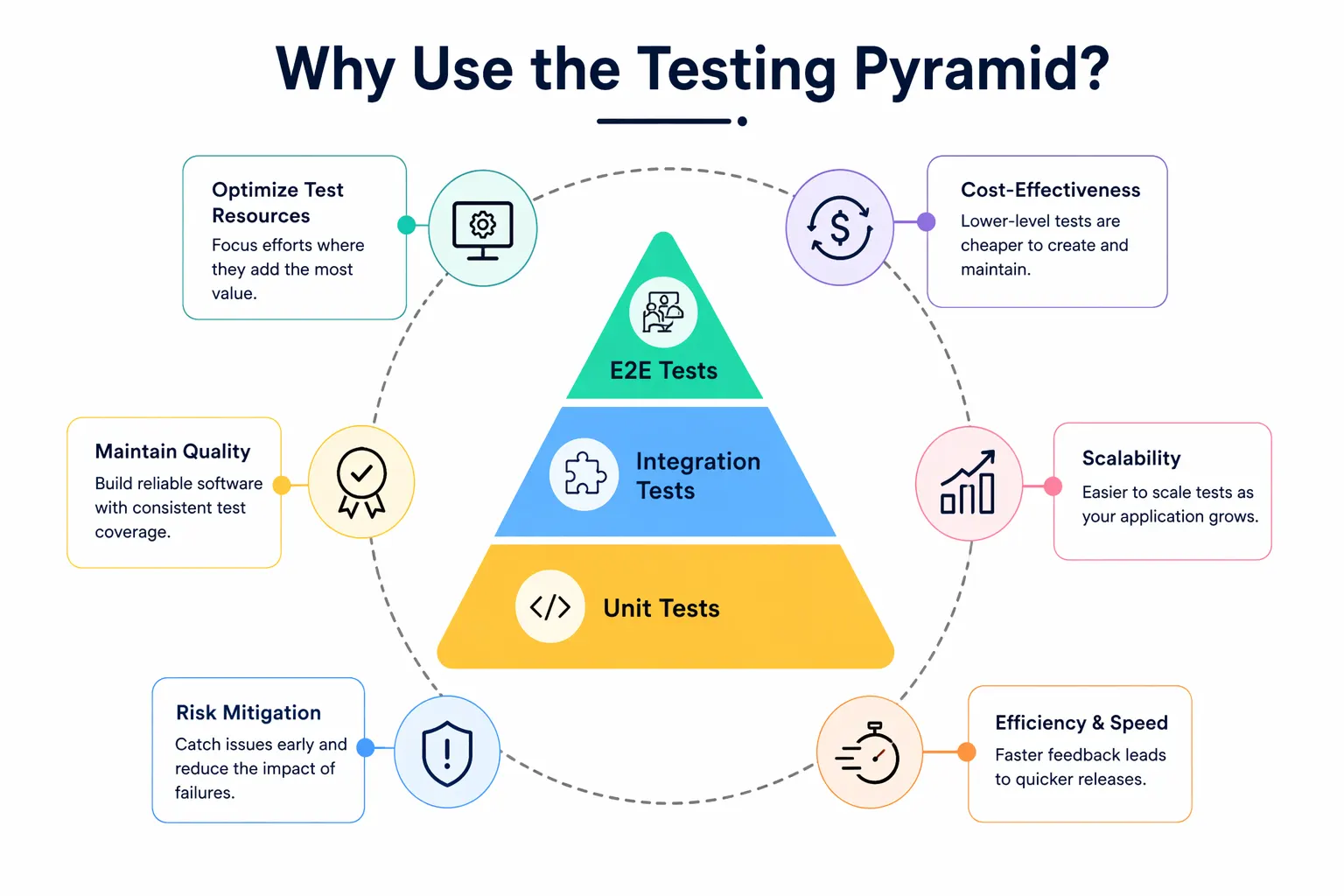
Teams that invert this - relying heavily on slow end-to-end testing for coverage - end up with test suites that take hours to run, break often, and give poor signal about where problems actually are. The Google Testing Blog has detailed case studies on how teams successfully restructured their test pyramids to reduce suite runtimes by 60–80%.
Combined with shift-left testing, the pyramid means defects get caught at the layer where they're cheapest to fix. Full-stack testing, done well, distributes coverage across all layers rather than concentrating it at the expensive end.
QA Trends Worth Watching
Cloud-based testing services remove the infrastructure overhead of managing test environments in-house. Cloud-based testing scales with your pipeline rather than requiring upfront capacity planning.
Mobile App Testing Services and Web Application Testing Services are converging as applications become cross-platform. Testing across device types, OS versions, and browsers is table stakes for consumer-facing products.
Load testing services are getting more accessible through cloud infrastructure - running realistic load scenarios no longer requires a dedicated performance lab.
QA automation testing services are evolving beyond script execution into full observability and intelligence layers that flag coverage gaps and test reliability issues automatically.
Emerging areas like quantum-safe algorithms and neuromorphic computing systems will require new testing approaches - these systems have failure modes that traditional functional testing frameworks weren't designed to catch. NIST's post-quantum cryptography standards are already reshaping what "security testing" means for forward-looking engineering teams.
A Practical Note on Strategy
Most QA problems aren't tool problems. The gaps tend to be in strategy: insufficient coverage at the unit and integration level, poor test data management, staging environments that don't reflect production, and test suites that accumulate technical debt until they become unreliable.
Digital transformation doesn't make this easier - it adds more systems, more interfaces, and more places for things to break. QA teams and Quality Engineers who focus on fundamentals first - coverage strategy, environment parity, stable automation, clear ownership - are better positioned to layer AI testing and agentic AI capabilities on top of that foundation.
Without the foundation, advanced tooling just automates the chaos faster.
Conclusion
Software testing hasn't become optional or easier - it's become continuous, distributed, and tightly coupled with how modern systems are built and shipped. The fundamentals still matter: strong unit coverage, reliable integration testing, realistic environments, and disciplined test data management. But applying those fundamentals at today's scale requires something more - automation, intelligent prioritization, and feedback loops that operate in real time.
BNXT.ai works with engineering teams to close that gap. From stabilizing flaky pipelines and improving test coverage to implementing AI-driven test automation and predictive quality engineering, the focus is on building testing systems that scale with your architecture, not against it.
People Also Ask

What is the role of software testing in DevOps?
Software testing is what makes continuous delivery safe. Automated testing in CI/CD pipelines catches regressions before they reach users, while performance engineering and monitoring catch what testing misses in production. QA testing services that integrate directly into DevOps pipelines give teams faster feedback loops and lower incident rates.
What is AI-powered testing?
AI-powered testing applies Machine Learning and predictive analytics to automate test creation, execution analysis, and coverage optimization. It includes self-healing test scripts, risk-based prioritization, and increasingly, agentic AI approaches where systems operate more autonomously. It's useful for specific problems - not a replacement for a QA strategy.
What is shift-left testing?
Shift-left testing means moving quality checks earlier in the development cycle - into code review, design, and early integration rather than pre-release. It reduces the cost of finding bugs by catching them before they propagate through the system.
What is the test pyramid?
The test pyramid is a testing strategy framework recommending a large base of unit tests, a moderate layer of integration tests, and a small number of end-to-end tests. It optimizes for speed and signal quality - fast tests at the bottom, comprehensive but expensive tests reserved for critical paths at the top.
What is test data management in software testing?
Test data management is the process of creating, maintaining, and provisioning reliable datasets for testing environments. It ensures that automated and manual tests run against realistic, consistent, and compliant data conditions. This includes using synthetic data generation to avoid risks tied to sensitive information (like financial or healthcare data), regularly refreshing datasets to prevent staleness, and aligning test data closely with production scenarios. Strong test data management improves test accuracy, reduces false positives/negatives, and helps teams catch real-world issues before deployment.


.webp)
.webp)
.webp)

.webp)
.webp)