
.png)
.webp)
Send a carefully crafted email campaign today and there's a decent chance it gets opened Thursday. Maybe. A WhatsApp message lands and gets read in four minutes.
That's not a marketing insight. That's just how people use their phones.
WhatsApp messages see open rates above 90% compared to email's 20-25% on a good day. That gap isn't closing. Businesses still treating messaging as a secondary channel aren't just being slow; they're actively losing leads to whoever responds first.
This blog covers how WhatsApp API and SMS API solutions improve customer engagement through real-time, automated communication. It also explains their differences, pricing models, use cases, and how to choose the right messaging API for your business.
Why Messaging APIs Are Critical for Modern Customer Engagement
A missed follow-up within the first hour of a demo request drops conversion by 7x, according to Harvard Business Review. Most CRM queues don't move that fast — and that's before accounting for timezone gaps, weekend coverage, or agents working five tools at once.
A well-integrated messaging API fixes most of that through timing connecting your messaging layer to the systems that hold customer data so the right message reaches the right person at the right point in their customer journey.
Real-Time Messaging as a Growth Driver
SMS open rates reach 98%, with most messages read within three minutes (SimpleTexting, 2024 Benchmark Report). Email sits at 20-25% on a good day. Opt-in rates for WhatsApp Business messaging run higher than email in most B2C categories customers associate the channel with personal communication, not marketing noise, and that trust shows up directly in response rates.
In India, the UAE, UK, and Australia, WhatsApp has replaced email as the default channel customers expect for support not an alternative people settle for when email goes unanswered, but the first place they reach out.
Powering End-to-End Customer Engagement with APIs
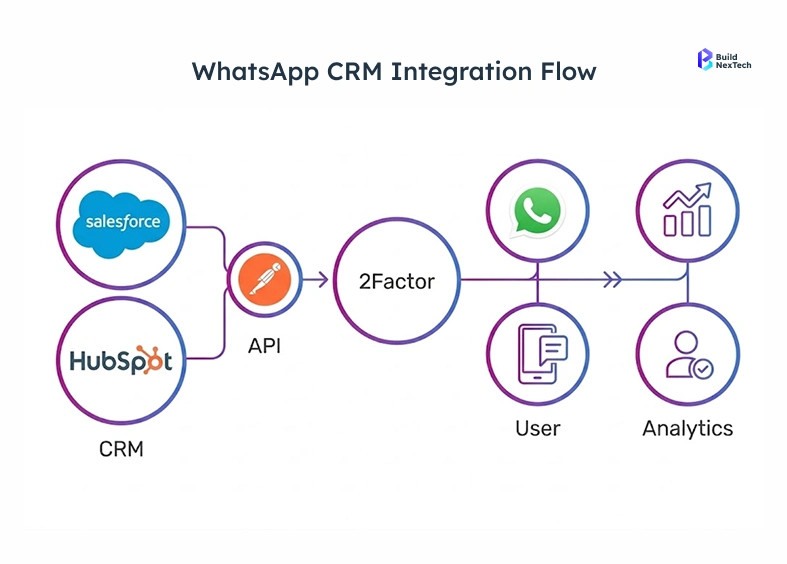
A messaging API connects your communication layer to order management, CRM, support desk, and marketing automation. Messages go out based on what's actually happening in the customer relationship rather than on a scheduled batch. Support ticket crosses SLA, a WhatsApp notification hits the customer automatically. Lead hits a score threshold in your CRM, the sales rep gets notified and a follow-up sequence starts.
Nobody triggers any of that manually. The automation workflows handle it.
The integration layer is where most messaging projects fail quietly. The API works fine, but the CRM doesn't update, the agent console doesn't route correctly, and six months later the team is back to manual follow-ups. Getting the architecture right before volume scales is significantly cheaper than retrofitting it. A CRM database acts as the central system where all customer interactions, messages, and engagement history are stored. CRM analytics helps businesses analyze this data to understand customer behavior, optimize messaging campaigns, and improve response rates. Platforms like Microsoft CRM (Dynamics 365) support messaging API integration, allowing businesses to automate communication workflows directly within their CRM environment.
.webp)
WhatsApp API for Business: The New Engagement Frontier
As of 2024, the WhatsApp Business API covers broadcast messaging, two-way conversations, interactive message templates, in-chat flows, and rich media all via standard REST endpoints documented through Meta's Cloud API. WhatsApp response rates are generally higher than email in most B2C use cases, primarily due to higher open rates and real-time engagement. At this point the argument for ignoring it is thin, especially in markets where it's already the default support channel.
.webp)
Why WhatsApp API Is Outperforming Traditional Messaging Channels
WhatsApp reported 2 billion+ monthly active users as of Q4 2024 (Meta Investor Report). In India and the GCC, adoption sits above 90%. Push notification opt-in rates are significantly lower than messaging channels, and click-through rates remain limited for most categories. Bulk SMS has no rich media, no read receipts, and increasing carrier filtering for anything resembling marketing content.
WhatsApp carries personal trust and broadcast reach. End-to-end encryption comes standard relevant to customers paying closer attention to data privacy. Business verification through Meta means customers can see they're talking to a legitimate company, not a spoofed number.
Core Features That Make WhatsApp Business API a Powerhouse
To access the WhatsApp Business Platform, you need a WhatsApp Business Account linked to a verified business the entry point for template messages, bulk messaging, and full API access.
WhatsApp Templates are pre-approved structured messages sent at scale: appointment reminders, account verification codes, transaction alerts, order confirmations. The template system allows transactional messaging at volume without triggering spam detection. Template approval through a Meta Business Solution Provider typically takes 24-72 hours going direct through Meta without a BSP can double that.
Interactive CTA buttons inside approved messages let customers act without leaving the chat Track Order, Confirm Appointment, Contact Support. One tap, no app-switching.
Rich media messaging sends product images, PDF invoices, video walkthroughs, and multimedia content through one channel. Two-way messaging lets support teams handle inquiries and resolve issues in the same thread the original notification came from. WhatsApp Flows support structured in-chat interactions including forms, booking widgets, and surveys all handled inside the conversation thread without redirecting the customer to a browser.
WhatsApp API vs SMS API: Features, Pricing and Use Case Comparison
SMS and WhatsApp are good at different things. The businesses that get the best results usually use both. Here's a direct comparison without vendor spin.
Feature Comparison: SMS API vs WhatsApp API
.webp)
Pricing Models Explained: SMS vs WhatsApp API Costs
SMS pricing is per message, per destination country. International rates vary significantly parts of the Middle East run three to four times the US rate.
WhatsApp uses a conversation-based pricing model that varies by category (marketing, utility, authentication, and service) and by country. Meta restructured this pricing in June 2023 and again in February 2024, with marketing conversations taking the largest rate increases. One-time passcodes and account verification sit in the authentication tier. Outbound campaigns fall under marketing and cost more than service conversations. At high volume, costs compound fast if you're using WhatsApp as one-way broadcast rather than two-way conversational messaging.
At 500,000+ messages per month, routing strategy alone can cut costs by 15-25%. Channel mix, conversation categories, and provider redundancy all factor in. That's worth mapping before committing to a platform.
When to Use SMS vs WhatsApp for Maximum ROI
SMS is right for universal reach, delivery without internet dependency, and short transactional messages — OTPs, logistics alerts, mobile campaigns that need to land on every phone. WhatsApp works better when your market has high penetration, the message carries rich media, or the customer needs to respond. Abandoned cart sequences with product recommendations. KYC document collection. Support threads. Personalised communications based on purchase history.
Any business running campaigns across WhatsApp-dominant markets (India, GCC) and SMS-first markets (US, Japan) needs both channels. Trying to force one globally creates delivery gaps you won't catch until you check open rates by country. A single platform handling both through one integration is worth the upfront cost.
Choosing the Best Messaging API Integration for Your Business
Pick the wrong API and you're rebuilding your contact center workflow at scale. The API you choose determines what your sales team can automate, how inbound support gets routed, whether agents share a working inbox or dig through separate tools, and whether customer data feeds back cleanly into your CRM.
Most messaging API migrations fail at the CRM integration layer, not the API itself. That's where architecture decisions compound and where getting it right from the start is significantly cheaper than retrofitting at volume.
Key Use Cases of SMS and WhatsApp APIs Across Industries
E-commerce platforms use WhatsApp for order confirmations, shipping updates, and abandoned cart sequences.A mid-market e-commerce client using WhatsApp cart recovery reported a 23% lift in recovered revenue compared to email sequences on the same segment. SMS handles OTP verification and flash sale alerts where delivery speed matters most.
Healthcare uses WhatsApp appointment reminders that patients confirm with one reply no portal login required. Lab results go as PDF attachments. Follow-up care instructions reach patients in the channel where they actually read their messages. Missed appointment rates drop significantly when the reminder is a WhatsApp thread instead of an automated phone call.
Financial services use SMS for transaction alerts and fraud notifications where speed and regulatory requirements demand reliable delivery. WhatsApp handles KYC document collection and loan status updates with interactive CTA buttons that reduce inbound contact center volume.
B2B sales teams use WhatsApp for mobile sales engagement. A form fill triggers a message from the assigned rep within minutes covering the customer journey from first touch through proposal delivery in one thread.
SMS vs WhatsApp: Choosing the Right Channel for Your Business Needs
Where are your customers located? WhatsApp penetration in India and the GCC sits above 90%. In the US and Japan, SMS still has broader reach. Check your actual customer geography before committing budget.
What does your CRM already support? HubSpot and Salesforce both have WhatsApp integration. If your existing stack has a native pathway, that's faster than a custom build.
What volume are you projecting six months from now? At low volume, almost any provider works. At 500,000 messages per month, per-message cost differences compound into real money. Get quotes at your projected scale and ask specifically about global routing and regional support.
Is messaging going to be two-way or mostly broadcast? For inbound support flows, you need routing, assignment, escalation, and reporting that's a different product from a pure delivery API.
Twilio vs Other Messaging API Providers: Feature and Pricing Comparison
Twilio is the default choice for teams with dedicated engineering resources. For businesses without a developer available to debug a webhook at short notice, alternatives like Wati or 360dialog get you live faster with less custom work. Here's how the main providers compare:
Twilio gives you the most control and the widest integration surface. The tradeoff is setup complexity and the assumption that someone on your team can own the configuration. If that's not the case, 360dialog and Wati include shared inboxes and multi-agent access out of the box. Route Mobile is worth a look if compliance and regional support in GCC or South Asia matter to your use case.
Conclusion: Build Smarter Engagement with the Right Messaging API
Businesses running WhatsApp for customer support alongside SMS for transactional alerts consistently outperform single-channel setups on response time and resolution rate. The channel combination matters less than the integration a well-connected CRM will outperform a manually managed inbox on any platform.
SMS handles delivery in low-connectivity markets and time-sensitive transactional messages. WhatsApp handles the conversation when the customer actually wants to respond. Most businesses operating across multiple geographies need both, and the decision of which platform to run them on is mostly a function of your team's technical capability and what your CRM already supports.
Most teams underestimate the conversation volume needed before WhatsApp pricing starts to compound. Run a 30-day pilot on a single use case support, cart recovery, or appointment reminders before committing to a platform-wide migration. That pilot will tell you more about what you actually need than any vendor comparison sheet.
How BuildNexTech Helps You Deploy the Best WhatsApp and SMS API Solutions
At BuildNexTech, the implementation work covers CRM and helpdesk integration, multi-agent shared inbox configuration, and WhatsApp automation flows built around the workflows your team already runs. Whether you're building on Twilio, 360dialog, Route Mobile, or Meta's Cloud API directly, the configuration layer is where most projects succeed or quietly fall apart.
If you're evaluating providers or planning a migration, the first conversation is usually about what your CRM currently does and what it needs to do once messaging is running at volume. That's where the architecture decisions happen before any code gets written.
People Also Ask

1. What is the difference between an SMS API and a WhatsApp API, and which one should my business use?
SMS works on all phones and is best for OTPs and urgent alerts. WhatsApp supports rich media and two-way conversations, making it better for support and engagement. Most businesses use both based on use case and geography.
2. How does SMS API integration work with an existing CRM like HubSpot or Salesforce?
SMS APIs connect to CRM workflows via native integrations or tools like Zapier. Messages trigger based on lifecycle events, and delivery data syncs back to contact records automatically.
3. Is Twilio the best WhatsApp and SMS API provider, or are there better alternatives for small businesses?
Twilio is powerful but developer-heavy. Tools like Vonage, Infobip, or 360dialog offer simpler setup, built-in inboxes, and competitive pricing for non-technical teams.
4. How does workflow automation in CRM improve the effectiveness of SMS and WhatsApp campaigns?
Automation sends messages based on real-time actions—like form fills or ticket delays—so communication feels timely and relevant, not broadcast-driven.
5. What factors affect SMS API pricing, and how can businesses manage messaging costs as they scale?
Pricing depends on country, message length, and volume tiers. Costs can be reduced by optimizing templates, routing messages efficiently, and consolidating providers.


.webp)
.webp)
.webp)

.webp)
.webp)