

AI Ops
Equipment doesn't fail without warning. The warning just goes unread until it's too late.
Schedule a Technical Scoping Call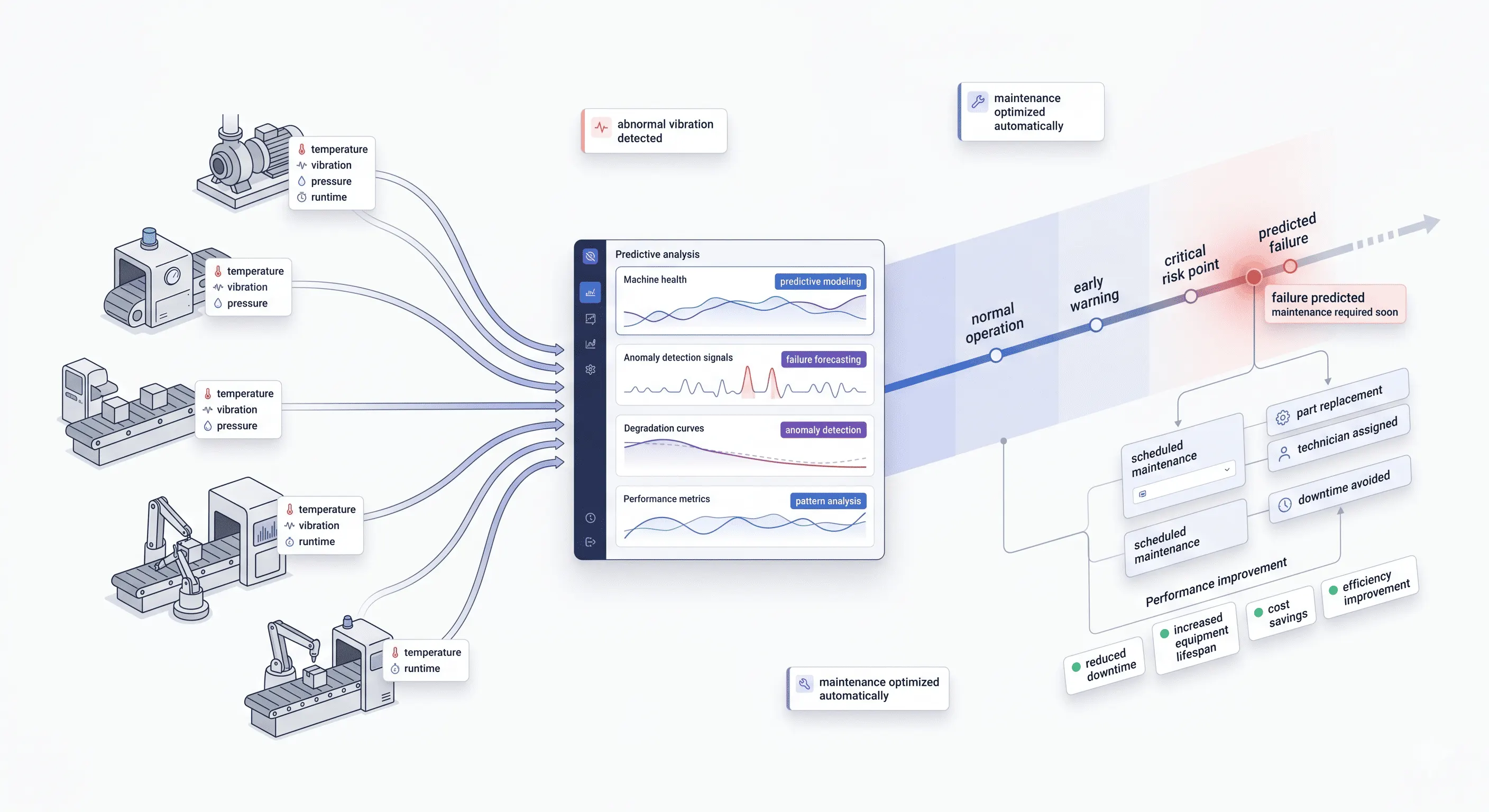
AI Ops
Equipment doesn't fail without warning. The warning just goes unread until it's too late.
Schedule a Technical Scoping CallMost maintenance operations run on one of two models: fix it when it breaks, or replace it on a fixed schedule. Both are expensive in different ways.
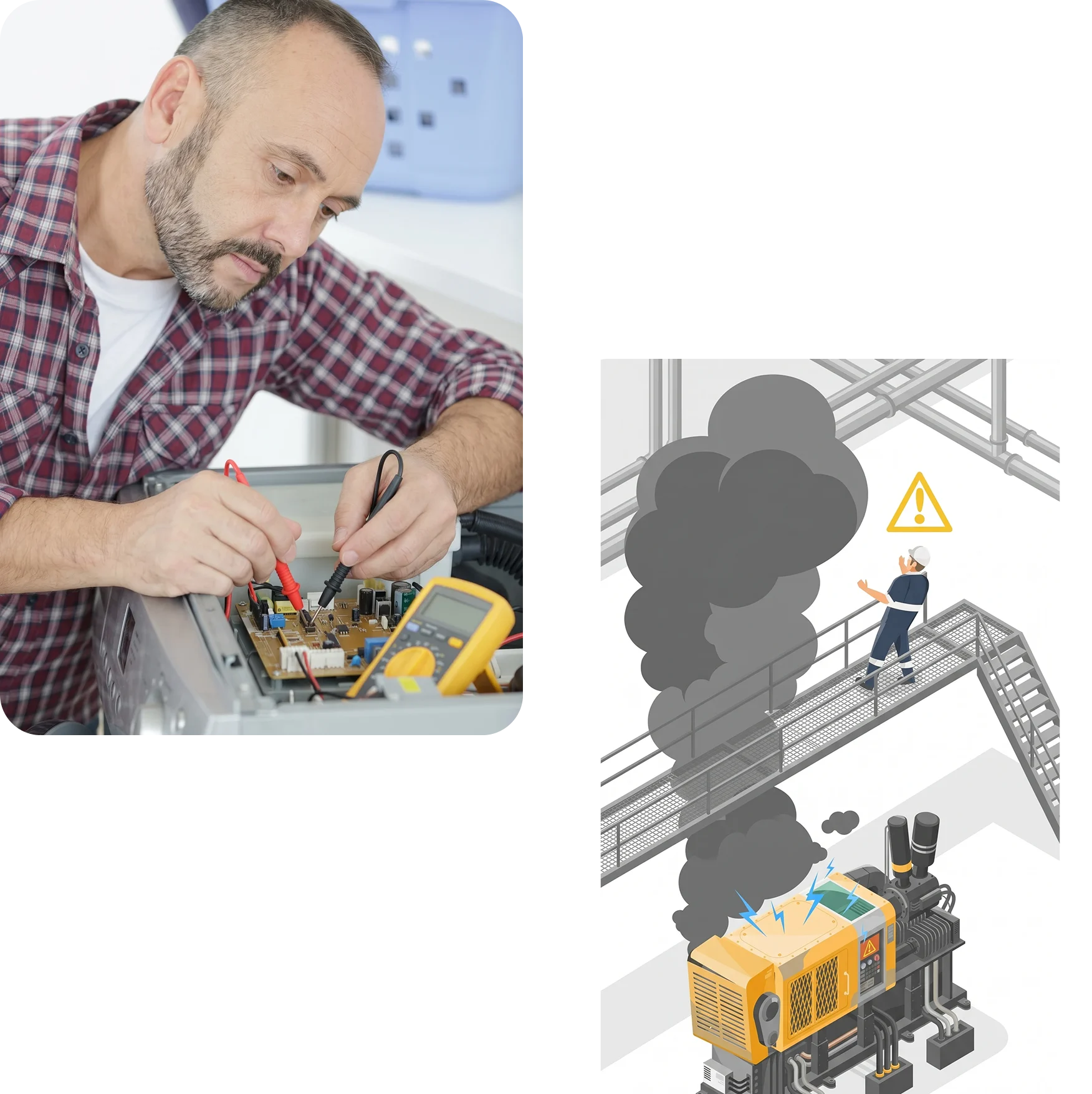
Reactive maintenance means unplanned downtime - the most costly event in any production environment. A single line stoppage in manufacturing can cost tens of thousands of dollars per hour. In utilities or logistics, the downstream effects compound quickly. Scheduled maintenance is more predictable but wasteful - components get replaced based on calendar intervals, not actual wear, meaning serviceable parts are swapped early. In contrast, genuinely degraded ones slip through between cycles.
The real problem with both models is the same: decisions are made without real-time data. Technicians work from inspection schedules and experience, not from what the machine is actually telling you right now.
We engineer custom, automated monitoring systems that continuously read equipment health and surface failure risk before it becomes downtime.

Sensor data ingested continuously from equipment across your facility or fleet - vibration, temperature, pressure, current draw.

ML models establish a health baseline for each asset and detect deviation patterns that precede failure.
Each asset receives a real-time degradation score and estimated remaining useful life.
This requires robust AI Integration to connect sensor infrastructure, CMMS platforms, and ERP systems - often augmented with Agentic AI to autonomously pull asset history, parts availability, and technician schedules before a work order is even opened. Explore our AI Services and AI Ops.
We reduce unplanned downtime and extend asset life.

Agentic AI maintenance assistant analyzed sensor data to detect anomalies, automate maintenance insights, and reduce machine downtime significantly across production workflows.
A custom model is trained to monitor and predict failure across your full asset base:
Early detection of bearing wear, shaft misalignment, and imbalance in motors, pumps, and compressors.
Anomaly detection across switchgear, transformers, and drives before thermal or load failures occur.
Continuous monitoring of chillers, cooling towers, and air handling units against efficiency and failure baselines.
Vehicle and heavy equipment health monitoring with route-aware wear modeling and predictive service scheduling.
Monitor hundreds of assets across a single facility with per-machine failure risk scoring updated in real time. See our AI Quality Inspection case study.
Predict failures in grid infrastructure and distribution assets before they cause outages. See our Predictive Infrastructure Management case study.
Keep fleets running with predictive service alerts before breakdown costs compound into missed SLAs. See our Agentic AI Logistics case study
Extend building system lifecycles and reduce emergency callouts across large commercial or industrial portfolios.
To build an accurate compliance automation layer, we require:
.png)
12+ months of historical compliance decisions, flagged records, and audit outcomes - with rule citations and reviewer dispositions labeled where available.
API access to your core banking or CRM platform, document management system, and any external data sources used in current compliance workflows - sanctions lists, PEP databases, credit bureaus.
All compliance data is encrypted at rest and in transit. Your compliance model is fully siloed - case data, decision records, and extracted document content are never shared or used to train models for other clients.
Off-the-shelf SaaS tools force your data into generic models with escalating per-transaction pricing. BNXT.ai offers
You own the model
and IP.
Trained exclusively on your transaction data, not global averages.
Sits natively inside your existing CRM and LOS - no clunky third-party dashboards.

The model's rule layer is separate from its pattern recognition layer. When regulations change, updated rules are applied to the screening logic without retraining the underlying model from scratch. For jurisdictions with frequent regulatory updates, we build automated rule ingestion pipelines that apply published regulatory changes to the model's configuration as they are issued.
Yes. Every decision the system makes - approval, escalation, rejection - is logged with the rule triggered, the evidence supporting the decision, the timestamp, and the outcome. Audit trail generation is built into the workflow, not assembled after the fact. Regulators receive a complete, structured evidence record rather than a manually compiled document package.
A custom compliance automation layer typically takes 10 to 14 weeks from data ingestion to live integration, depending on the number of regulatory frameworks being enforced, the complexity of your core system integrations, and the volume and quality of historical compliance data available for model training.
Records that fall outside the model's confidence threshold are never auto-approved or auto-rejected. They route to a human compliance officer with full context attached - the rule triggered, the evidence gathered, and the model's confidence score - so the reviewer has everything needed to make an informed decision rather than starting from scratch.
Yes. We build multi-jurisdiction models that maintain separate rule sets for different regulatory environments - so a transaction processed under GDPR in Europe and a different AML framework in the UAE is screened against the correct obligations for each context, not a single blended ruleset.

.webp)
.webp)
.webp)

BuildNexTech empowers businesses with expert web development, app development, and cloud migration services.




.webp)
.webp)
