

AI Security
Most attrition happens in the window between an employee disengaging and HR noticing. AI closes that window.
Schedule a Technical Scoping Call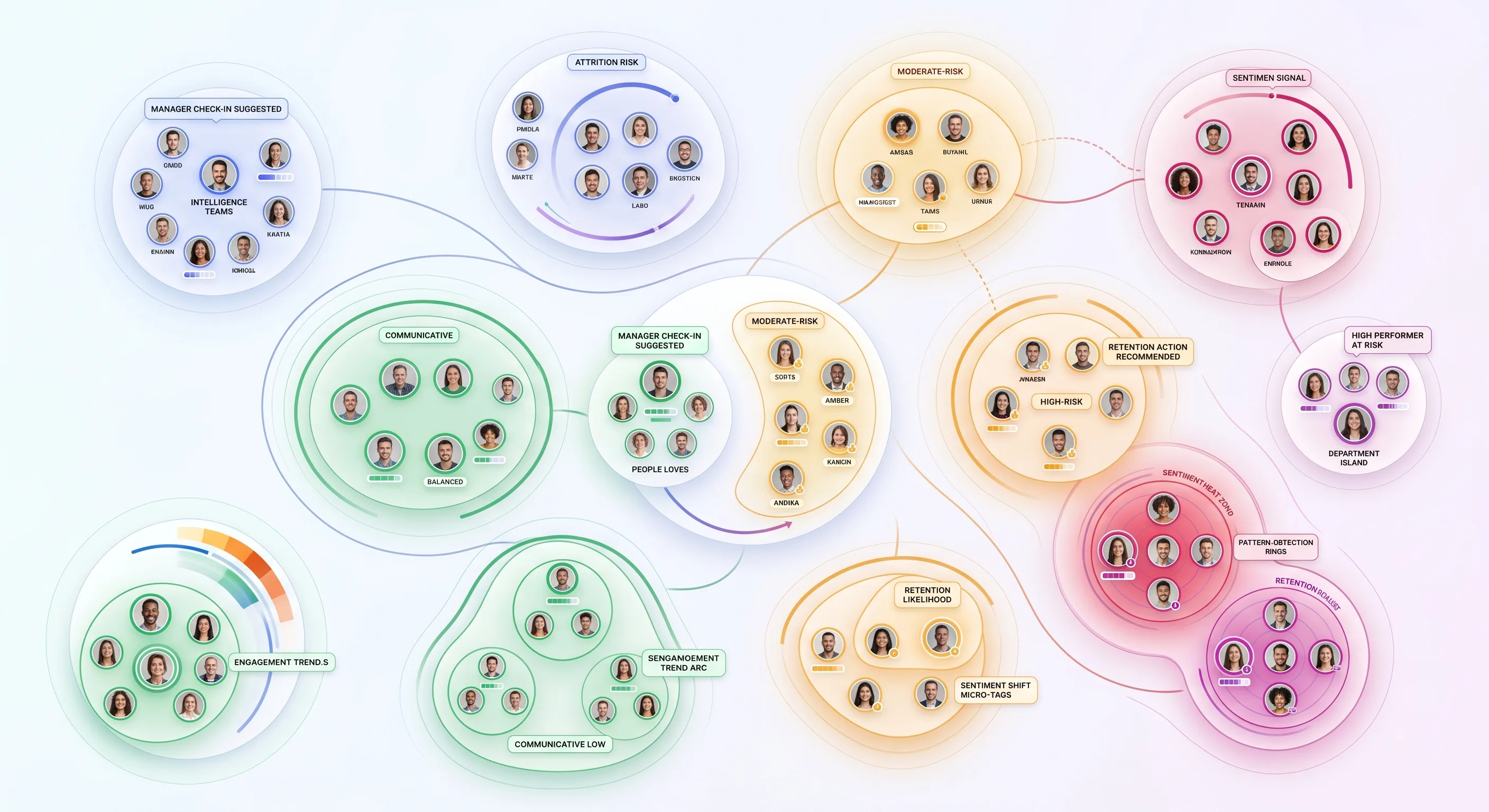
AI Security
Most attrition happens in the window between an employee disengaging and HR noticing. AI closes that window.
Schedule a Technical Scoping CallRule-based HR reporting trades insight for operational lag. Static dashboards and annual engagement surveys fail to adapt to shifting workforce sentiment, pushing your best employees out the door before retention interventions can be triggered. This visibility gap is exactly where your highest-performing talent quietly exits.
Overly reactive HR processes also generate high replacement costs that drain hiring budgets and slow team productivity, while HR business partners burn out managing crisis exits that were entirely predictable weeks earlier. The true cost of inaction isn't just a vacant role; it's lost institutional knowledge, damaged team morale, and recruitment overhead that compounds with every departure.

Rule-based HR reporting trades insight for operational lag. Static dashboards and annual engagement surveys fail to adapt to shifting workforce sentiment, pushing your best employees out the door before retention interventions can be triggered. This visibility gap is exactly where your highest-performing talent quietly exits.
Overly reactive HR processes also generate high replacement costs that drain hiring budgets and slow team productivity, while HR business partners burn out managing crisis exits that were entirely predictable weeks earlier. The true cost of inaction isn't just a vacant role; it's lost institutional knowledge, damaged team morale, and recruitment overhead that compounds with every departure.
We engineer custom, automated workflows operating continuously, sitting directly between your HRIS, performance systems, and people leadership - giving HR a real-time view of workforce health.
Real-time and batch data ingestion across HRIS, performance, payroll, and engagement platforms without latency.
ML models assess attrition risk signals and engagement anomalies against your historical workforce baseline.
Dynamic attrition risk scoring is instantly applied per employee and team cohort.
This requires robust AI Integration & AI Security to connect to your HRIS, ATS, and performance management infrastructure, often augmented with Agentic AI to autonomously surface relevant context - compensation benchmarks, promotion history, peer comparisons - before an HR business partner opens the case. Explore our AI Services.
We reduce attrition and accelerate workforce decisions.
A custom model learns to identify risk and opportunity across the full employee lifecycle:
Detecting early signals of burnout, role misalignment, or manager relationship breakdown.
Flagging employees whose pay has fallen materially below market benchmarks before it becomes a resignation trigger.
Identifying high-performers overdue for advancement who are statistically at elevated flight risk.
Surfacing cohorts with abnormal absenteeism, collaboration drop-off, or engagement decline before attrition cascades.
Protect critical talent pipelines across large distributed workforces with continuous attrition monitoring at scale.
Reduce frontline turnover in high-churn hourly roles with shift-level engagement signals and early intervention triggers.
Retain scarce technical talent by identifying compensation gaps and career stagnation risk before competitors do.
Reduce clinical staff burnout and attrition in high-pressure environments where vacancy directly impacts patient outcomes.
To build a highly accurate attrition prediction layer, we require:
.png)
12–24 months of HRIS records including tenure, performance ratings, compensation history, promotion timelines, and voluntary exit data.
API or direct integration with your HRIS (Workday, SAP SuccessFactors, BambooHR), performance management, and payroll platforms.
All data follows strict enterprise standards. Your custom model is siloed - your employee data is never shared across clients.
Off-the-shelf SaaS tools force your data into generic models with escalating per-transaction pricing. BNXT.ai offers
You own the model and IP.
Trained exclusively on your transaction data, not global averages.
Sits natively inside your existing CRM and LOS - no clunky third-party dashboards.

AI models evaluate hundreds of variables - tenure, compensation relative to market, performance trajectory, promotion history, manager tenure, absenteeism patterns, and engagement signals - continuously. By scoring these against your historical attrition patterns, the system flags at-risk employees weeks before a resignation lands on a manager's desk.
Traditional HR reporting tells you what already happened - headcount, turnover rate, exit survey themes. AI is predictive; it surfaces who is likely to leave and why, giving HR and managers enough lead time to intervene before the decision is made.
A custom enterprise model typically takes 8 to 12 weeks from data ingestion to deep HRIS and people dashboard integration, depending on data readiness and the number of source systems involved.
Yes. Because machine learning evaluates the full employee context across dozens of signals rather than triggering on a single threshold like tenure or last performance rating, it accurately differentiates between employees going through a temporary rough patch and those with genuine flight intent.
Yes. We engineer secure API middleware that allows modern machine learning models to communicate seamlessly with legacy HRIS platforms, on-premise payroll systems, and third-party engagement tools without data privacy compromise.

.webp)
.webp)
.webp)

BuildNexTech empowers businesses with expert web development, app development, and cloud migration services.




.webp)
.webp)
