

Agentic AI
Finance teams shouldn't spend the last week of every quarter assembling numbers. That time belongs to the analysis, not the spreadsheet.
Schedule a Technical Scoping Call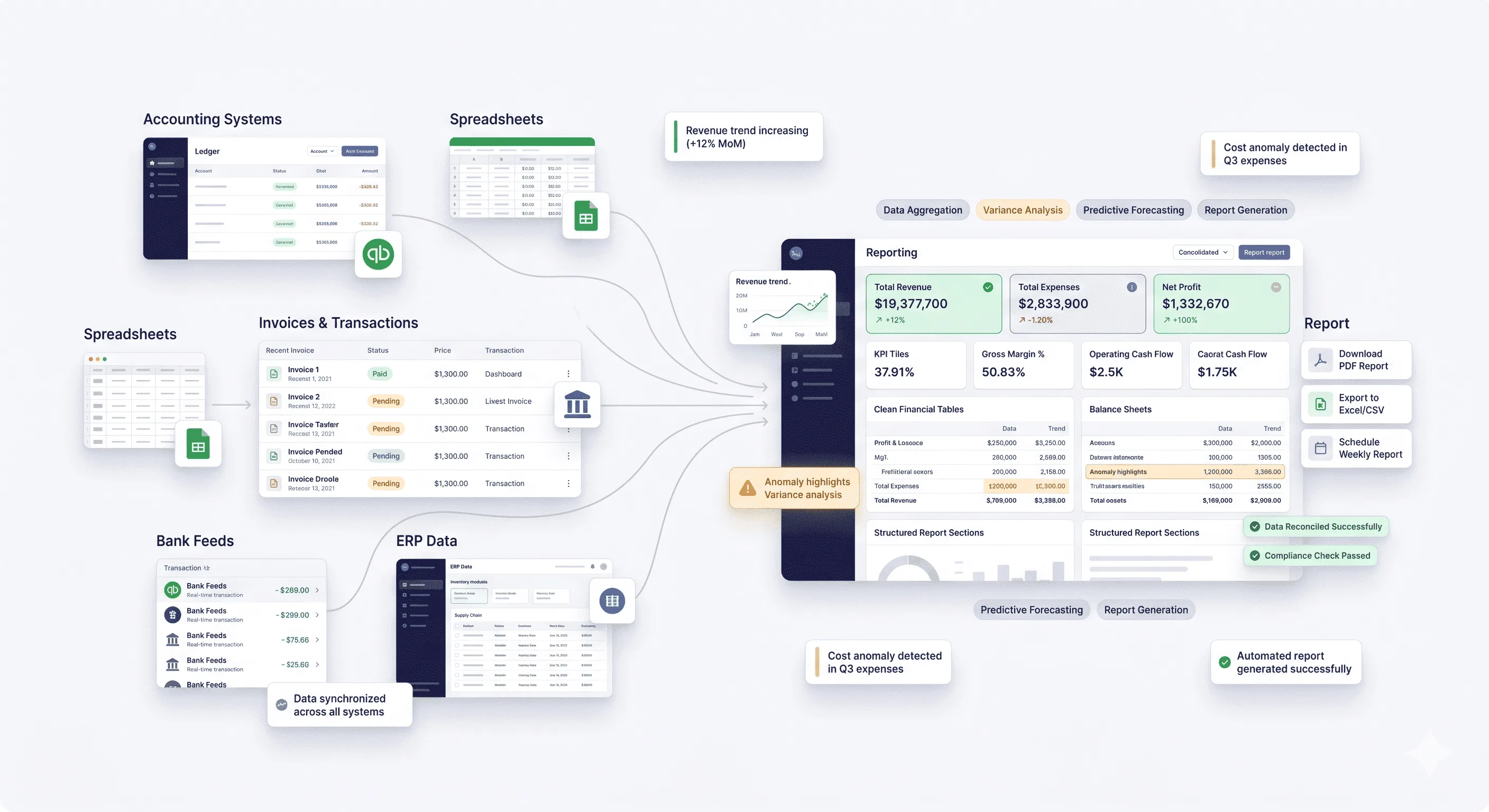
Agentic AI
Finance teams shouldn't spend the last week of every quarter assembling numbers. That time belongs to the analysis, not the spreadsheet.
Schedule a Technical Scoping CallMost finance teams run their reporting cycle the same way: pull data from multiple systems, reconcile discrepancies manually, build the deck in Excel, review it across three email threads, and hope nothing changed in the source data between the first pull and the final sign-off.
It works - until it doesn't. A formula error in a shared spreadsheet propagates undetected into a board presentation. A late data feed from a subsidiary pushes the close date by two days. A regulatory filing deadline approaches while the team is still consolidating figures from systems that don't talk to each other. Senior finance professionals who should be interpreting results spend their time extracting and formatting them instead.
The real cost isn't just the hours. It's the decisions made on stale data, the audit findings that trace back to a manual reconciliation step, and the strategic conversations that happen too late because the numbers weren't ready in time.
.webp)
Most finance teams run their reporting cycle the same way: pull data from multiple systems, reconcile discrepancies manually, build the deck in Excel, review it across three email threads, and hope nothing changed in the source data between the first pull and the final sign-off.
It works - until it doesn't. A formula error in a shared spreadsheet propagates undetected into a board presentation. A late data feed from a subsidiary pushes the close date by two days. A regulatory filing deadline approaches while the team is still consolidating figures from systems that don't talk to each other. Senior finance professionals who should be interpreting results spend their time extracting and formatting them instead.
The real cost isn't just the hours. It's the decisions made on stale data, the audit findings that trace back to a manual reconciliation step, and the strategic conversations that happen too late because the numbers weren't ready in time.
We engineer custom, automated financial reporting pipelines that consolidate, reconcile, generate, and distribute - closing the gap between data and decision without manual intervention.

Financial data ingested automatically from every source system - ERP, CRM, core banking platform, subsidiary ledgers - on a defined schedule or in real time.

AI models identify discrepancies, duplicate entries, and classification mismatches across data sources - flagging exceptions for review rather than letting them surface in the final report.

Reports, dashboards, and regulatory filings are produced automatically from clean, reconciled data - formatted to your templates and distributed to the right stakeholders on schedule.
This requires robust AI Integration to connect reporting logic across your ERP, core banking, and data warehouse infrastructure - often augmented with Agentic AI to autonomously gather subsidiary data, apply exchange rate adjustments, and flag regulatory threshold breaches before a report reaches a human reviewer. Explore our AI Services and Business Intelligence.
We compress reporting cycles and give finance teams their time back for work that actually requires judgment.

Custom financial LLM automated quarterly analysis, insights extraction, and report generation - saving research and finance teams over 30 hours every week.
A custom model is built to automate the full range of financial reporting your organization produces:
Automated production of regulatory filings against applicable frameworks - formatted to regulator specifications and populated from reconciled source data. See our Autonomous Compliance Agent work.
Real-time revenue tracking against forecast, with automated variance analysis and pipeline-to-close projections updated continuously. See our BI-Driven Revenue Projections case study.
Automated extraction of key metrics, disclosures, and comparative figures from earnings reports and regulatory filings - with structured summaries generated at ingestion. See our Custom Financial LLM case study.
Automated consolidation of spend data across departments, vendors, and cost centers - with anomaly detection flagging unusual patterns before they hit the close report.
Automate regulatory reporting, ledger reconciliation, and exception reporting across high transaction volumes without proportionally scaling your finance operations team. See our Financial ERP Cloud Migration work.
Close faster with automated revenue recognition, ARR reporting, and cohort-level financial analysis updated in real time from your billing and CRM systems.
Automate claims cost reporting, reserve calculations, and regulatory submissions - with audit trails generated at every step. See our AI Claims Verification work.
Consolidate financial data across channels, regions, and payment processors into unified reporting - with margin and ad spend analytics updated continuously. See our BI Ad Spend Analytics work.
To build an accurate financial reporting automation layer, we require:
.png)
12–24 months of historical financial records across your source systems - general ledger, billing platform, ERP, and any subsidiary or consolidated reporting structures.
API access to your ERP (SAP, Oracle, NetSuite, or equivalent), core banking or billing platform, and data warehouse or BI layer if applicable.
All financial data is encrypted at rest and in transit. Your reporting models and financial data are fully siloed - never shared or used to train models for other clients.
Off-the-shelf SaaS tools force your data into generic models with escalating per-transaction pricing. BNXT.ai offers
You own the model and IP.
Trained exclusively on your transaction data, not global averages.
Sits natively inside your existing CRM and LOS - no clunky third-party dashboards.

We build data normalization layers that map fields from each source system to a unified financial data model before reconciliation and reporting logic is applied. This means your ERP, CRM, billing platform, and subsidiary ledgers can all contribute to consolidated reports without requiring manual data alignment between each close cycle.
Yes. We build consolidation logic that applies exchange rate adjustments, intercompany elimination rules, and entity-level reporting hierarchies automatically - so consolidated group reports are produced from the same pipeline as individual entity reports, without a separate manual consolidation step.
A custom financial reporting automation layer typically takes 10 to 14 weeks from data ingestion to live reporting, depending on the number of source systems being connected, the complexity of your consolidation structure, and the volume of report types being automated.
Every data point in every generated report is traced back to its source record - system, timestamp, and transformation applied. Audit trail documentation is generated automatically as part of the reporting workflow, not assembled after the fact when an audit request arrives.
The system flags missing or delayed data feeds before report generation runs - identifying which source systems haven't delivered and what impact the gap has on specific report sections. Reports are not generated with silent gaps; exceptions surface to the finance team with enough lead time to resolve them before distribution deadlines.

.webp)
.webp)
.webp)

BuildNexTech empowers businesses with expert web development, app development, and cloud migration services.




.webp)
.webp)
