

Agentic AI
Compliance failures rarely happen because nobody cared. They happen because the volume made manual oversight impossible.
Schedule a Technical Scoping Call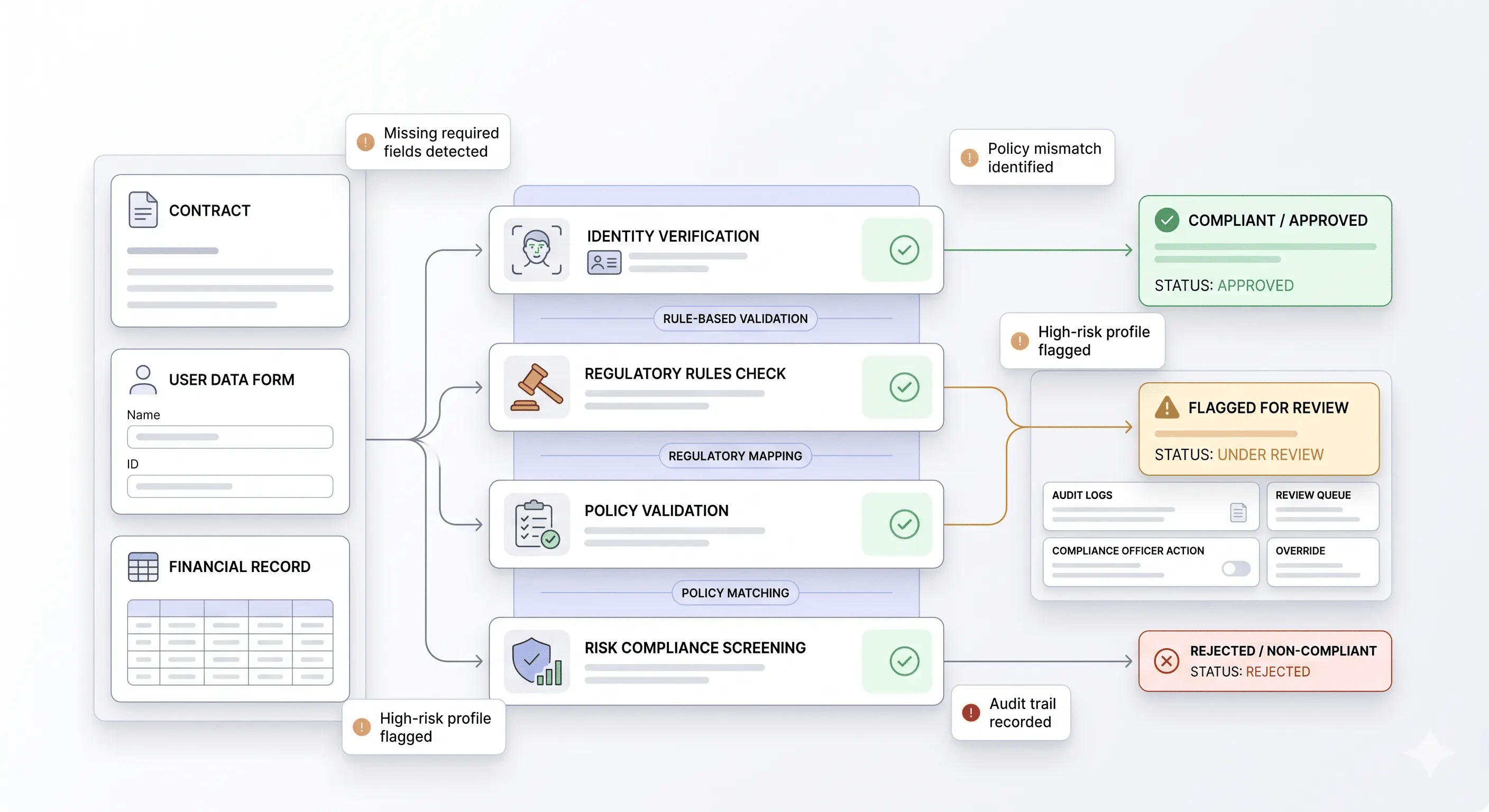
Agentic AI
Compliance failures rarely happen because nobody cared. They happen because the volume made manual oversight impossible.
Schedule a Technical Scoping CallRegulatory compliance runs on documentation, verification, and audit trails - and in most organizations, all three depend heavily on human reviewers working through queues that grow faster than headcount can keep up with.
The math breaks down at scale. A compliance team reviewing hundreds of transactions, contracts, or onboarding submissions per day cannot maintain consistent accuracy across every record. Fatigue introduces error. Regulatory changes require retraining entire teams before updated rules can be applied reliably. And when an audit arrives, assembling evidence across disconnected systems takes weeks of work that should take hours.
The risk isn't just regulatory fines. It's the reputational exposure from a compliance failure that was technically preventable, the operational drag of a team spending most of its time on low-judgment verification tasks, and the deals delayed or lost because onboarding and approval cycles run too slowly to compete.
.png)
We engineer custom, automated compliance layers that screen, verify, flag, and report - operating continuously across your transaction, document, and onboarding volumes without manual bottlenecks.

Transactions, documents, onboarding submissions, and operational records pulled continuously from your core systems and queued for compliance screening.

AI models apply your current regulatory ruleset - AML, KYC, sanctions, policy thresholds - to every record in real time, not in batches.

Each record receives a risk score and compliance status. Clean records clear automatically. Flagged records are tagged with the specific rule triggered and the evidence supporting the flag.
This requires robust AI Integration to connect screening logic across your core banking, CRM, and document management systems - often augmented with Autonomous AI Agents to autonomously gather supporting evidence, cross-reference sanctions lists, and populate case files before a compliance officer opens the record. Explore our AI Services and Agentic AI.
We eliminate compliance backlogs and reduce the cost of staying audit-ready.

Secure AI document verification cut claim processing time from 48 hours to 6 hours while maintaining full compliance with data handling and security requirements.
A custom model is trained to enforce your specific regulatory obligations across the full compliance surface:
Continuous screening of transactions against behavioral baselines, velocity rules, and typology patterns - flagging suspicious activity before it compounds. See our Real-Time Fraud Detection work.
Automated identity document verification, sanctions screening, and PEP checks across new account and onboarding submissions - clearing clean applicants instantly and routing exceptions for review.
Clause-level review of contracts against approved templates and regulatory standards - flagging deviations, missing obligations, and non-standard terms before execution. See our Legal-Domain LLM work
Automated generation of compliance reports, suspicious activity reports, and audit-ready evidence packages - assembled from live system data rather than manual extraction.
Automate claims compliance verification, policy document checks, and fraud pattern screening before payout decisions are made. See our Automated Claims Verification case study.
Apply regulatory and policy standards consistently across high-volume contract review and case file classification workflows. See our Legal LLM case study.
Maintain HIPAA compliance across patient records, billing submissions, and clinical documentation at the volume modern healthcare operations require
Keep pace with regulatory change across multiple jurisdictions without rebuilding rule logic from scratch every time requirements shift.
To build an accurate compliance automation layer, we require:
.png)
12+ months of historical compliance decisions, flagged records, and audit outcomes - with rule citations and reviewer dispositions labelled where available.
API access to your core banking or CRM platform, document management system, and any external data sources used in current compliance workflows - sanctions lists, PEP databases, credit bureaus.
All compliance data is encrypted at rest and in transit. Your compliance model is fully siloed - case data, decision records, and extracted document content are never shared or used to train models for other clients.
Off-the-shelf SaaS tools force your data into generic models with escalating per-transaction pricing. BNXT.ai offers
You own the model
and IP.
Trained exclusively on your transaction data, not global averages.
Sits natively inside your existing CRM and LOS - no clunky third-party dashboards.

The model's rule layer is separate from its pattern recognition layer. When regulations change, updated rules are applied to the screening logic without retraining the underlying model from scratch. For jurisdictions with frequent regulatory updates, we build automated rule ingestion pipelines that apply published regulatory changes to the model's configuration as they are issued.
Yes. Every decision the system makes - approval, escalation, rejection - is logged with the rule triggered, the evidence supporting the decision, the timestamp, and the outcome. Audit trail generation is built into the workflow, not assembled after the fact. Regulators receive a complete, structured evidence record rather than a manually compiled document package.
A custom compliance automation layer typically takes 10 to 14 weeks from data ingestion to live integration, depending on the number of regulatory frameworks being enforced, the complexity of your core system integrations, and the volume and quality of historical compliance data available for model training.
Records that fall outside the model's confidence threshold are never auto-approved or auto-rejected. They route to a human compliance officer with full context attached - the rule triggered, the evidence gathered, and the model's confidence score - so the reviewer has everything needed to make an informed decision rather than starting from scratch.
Yes. We build multi-jurisdiction models that maintain separate rule sets for different regulatory environments - so a transaction processed under GDPR in Europe and a different AML framework in the UAE is screened against the correct obligations for each context, not a single blended ruleset.

.webp)
.webp)
.webp)

BuildNexTech empowers businesses with expert web development, app development, and cloud migration services.




.webp)
.webp)
