

AI Security
Most claims errors and delays happen in the window between submission and manual adjudication. AI closes that window.
Schedule a Technical Scoping Call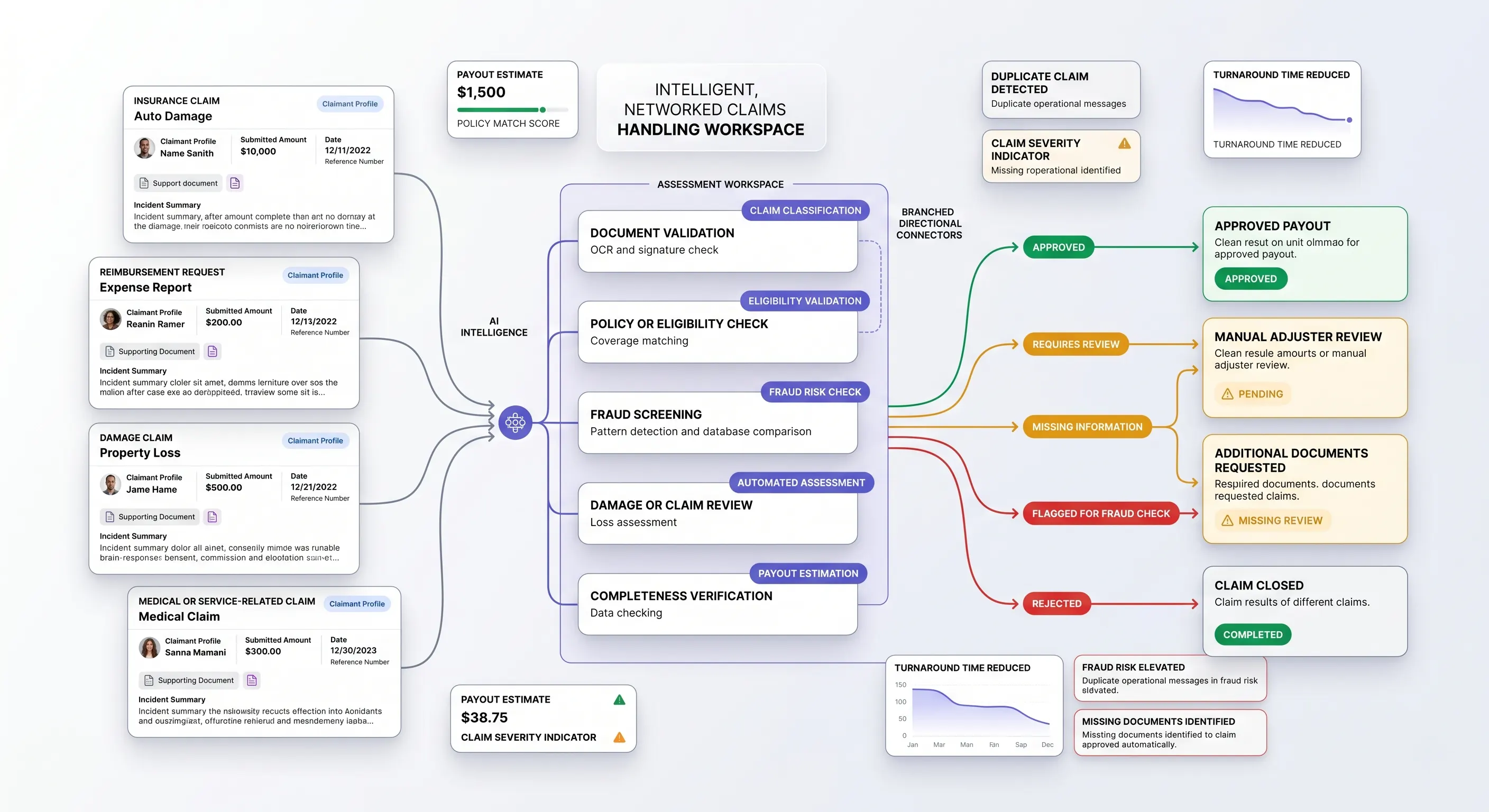
AI Security
Most claims errors and delays happen in the window between submission and manual adjudication. AI closes that window.
Schedule a Technical Scoping CallRule-based claims processing trades speed for operational drag. Rigid workflows fail to adapt to new fraud vectors and edge-case policy interpretations, pushing thousands of claims into manual review queues. This operational lag is exactly where leakage, fraud, and customer churn happen.
Overly conservative rulesets also generate high false-flag rates that delay legitimate claimants, driving immediate dissatisfaction and policy cancellations, while adjusters burn out triaging low-confidence alerts. The true cost of inaction isn't just paid fraud; it's lost policyholder trust, bloated overhead, and regulatory exposure.

Rule-based claims processing trades speed for operational drag. Rigid workflows fail to adapt to new fraud vectors and edge-case policy interpretations, pushing thousands of claims into manual review queues. This operational lag is exactly where leakage, fraud, and customer churn happen.
Overly conservative rulesets also generate high false-flag rates that delay legitimate claimants, driving immediate dissatisfaction and policy cancellations, while adjusters burn out triaging low-confidence alerts. The true cost of inaction isn't just paid fraud; it's lost policyholder trust, bloated overhead, and regulatory exposure.
We engineer custom, automated workflows operating in milliseconds, sitting directly between your claims intake system and your core policy administration platform.

Real-time claims data ingestion across all submission channels without latency.

ML models evaluate coverage eligibility, policy conditions, and fraud signals against your historical baseline.

Dynamic risk and validity scoring is instantly applied per claim.
This requires robust AI Integration & AI Security to connect to legacy policy administration systems, often augmented with Agentic AI to autonomously gather supporting documentation and third-party data before an adjuster opens the file. Explore our AI Services.
We stop leakage and accelerate adjudication.

$1.4M prevented annually in improper payments, 65% faster adjudication cycles, 42% fewer false denials.
A custom model learns to identify risk and anomalies across the full claims spectrum:
Staged incidents, inflated valuations, and duplicate submissions across channel.
Upcoding, unbundling, and phantom procedure patterns in healthcare claims.
Automated verification of altered supporting documents, receipts, and medical records.
Detecting synthetic or stolen identities during first notice of loss.
Automate high-volume auto and home claims with straight-through processing for low-complexity cases.
Accelerate prior authorizations and medical claims adjudication while flagging billing anomalies.
Detect exaggerated injury claims and flag providers with anomalous billing patterns.
Identify policy misrepresentation and verify eligibility at submission without friction for legitimate claimants.
To build a highly accurate claims processing layer, we require:
.png)
6–12 months of historical claims records with adjudication outcomes and labeled fraud instances.
API access to your claims management system, policy administration platform, and third-party data sources.
All data follows strict enterprise standards. Your custom model is siloed - your data is never shared across clients.
Off-the-shelf SaaS tools force your data into generic models with escalating per-transaction pricing. BNXT.ai offers
You own the model and IP.
Trained exclusively on your transaction data, not global averages.
Sits natively inside your existing CRM and LOS - no clunky third-party dashboards.

AI models evaluate hundreds of variables - claimant history, policy terms, incident data, third-party records, and document authenticity - in milliseconds. By scoring these against known patterns, the system approves, denies, or escalates claims before an adjuster touches the file.
Rule-based systems rely on strict manual criteria easily exploited by sophisticated fraud schemes or overwhelmed by policy complexity. AI is dynamic; it learns hidden relationships between variables, adapting automatically as fraud tactics evolve and policy portfolios change.
A custom enterprise model typically takes 8 to 12 weeks from data ingestion to deep claims system integration, depending on data readiness and infrastructure complexity.
Yes. Because machine learning evaluates the full claim context rather than triggering on a single strict rule, it accurately differentiates between legitimate edge-case claims and actual fraud or ineligibility - protecting both your loss ratio and your policyholder relationships.
Yes. We engineer secure API middleware that allows modern machine learning models to communicate seamlessly with legacy core systems, on-premise claims platforms, and third-party data providers without introducing processing latency.

.webp)
.webp)
.webp)

BuildNexTech empowers businesses with expert web development, app development, and cloud migration services.




.webp)
.webp)
