
Our enterprise AI infrastructure helps hospitals and telehealth platforms scale patient volume and meet strict HIPAA compliance demands without linearly increasing administrative headcount.
80%
Reduction in manual healthcare reporting effort.
4x
Scaling of daily virtual teleconsultations.
3x
Faster Delivery of clinical performance insights.
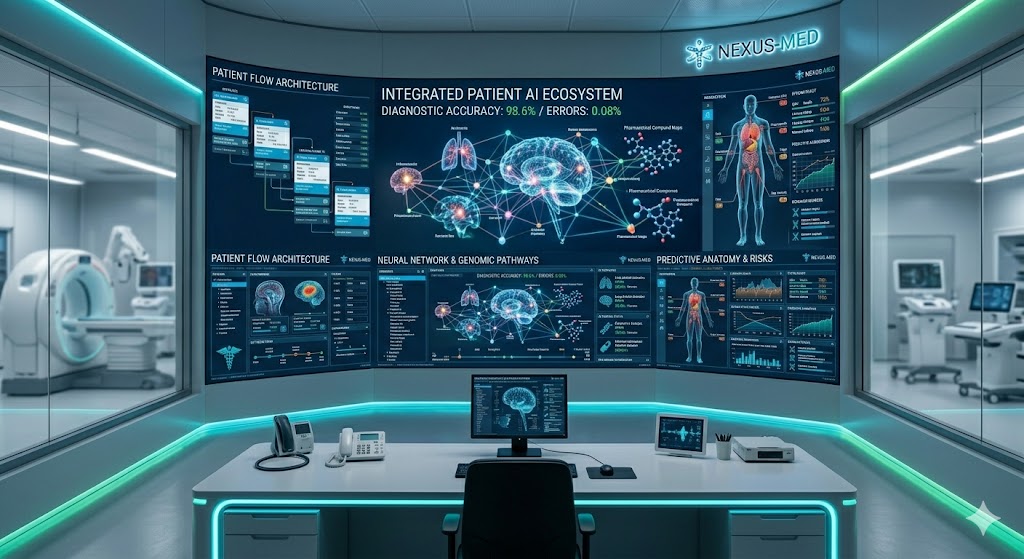
AI delivers the highest ROI in data-heavy, heavily regulated clinical and administrative processes. Here is how we apply it:

AIaaS predictive analytics engines aggregate patient data, reducing manual reporting effort by 80%.

Custom apps with AI scheduling scale virtual visits 4x and cut missed appointments by 68%.

Intelligent workflows instantly validate info, collect symptoms, and route to specialists.

Automate the extraction of billing codes directly into your RCM software to reduce claim denials.

Integrate IoT medical devices with predictive AI to monitor vitals and alert staff instantly.
We build AI systems inside regulated healthcare environments where patient data privacy (PHI), clinical explainability, and HIPAA compliance are non-negotiable.


Where AI Fits in the Healthcare Stack
AI enhances Electronic Health Records (EHR) and hospital management systems through a structured architecture:
%201.png)
Ingestion
Pull unstructured clinical notes and structured data from legacy EHRs.

Secure APIs
Model Layer
Localized LLMs ensure Protected Health Information (PHI) never leaves secure environments.

Human-in-the-Loop
AI handles tier-1 admin clinical and diagnostic decisions always route to medical professionals.
Common Healthcare Automation Challenges
.png)
Connecting modern AI to monolithic systems requires strict adherence to HL7 and FHIR standards.
Medical professionals demand transparent logic and clear audit trails for flagged patient risks.
Patient PHI must remain isolated; public LLMs cannot be used for clinical data.
Best Fit: Regulated networks processing high volumes with existing EHR infrastructure needing an intelligent layer.
Not a Fit: Off-the-shelf symptom checkers, generic chatbots, or non-clinical POCs.

Clinical reporting, patient intake and scheduling, medical billing data extraction, and remote telemedicine triage.
Yes. Secure implementation utilizes localized LLMs, customized API middleware, and strict role-based access controls for total PHI security.
Never. Through our HITL architecture, AI organizes data and flags anomalies, but human physicians make diagnostic decisions.
Admin implementations like automated scheduling take 8–12 weeks; deep clinical integrations require longer phased rollouts.
Yes. Custom API middleware acts as a secure bridge, interacting with legacy EHR databases securely via FHIR/HL7 standards.
.webp)
.webp)
.webp)

BuildNexTech empowers businesses with expert web development, app development, and cloud migration services.


.webp)
.webp)
